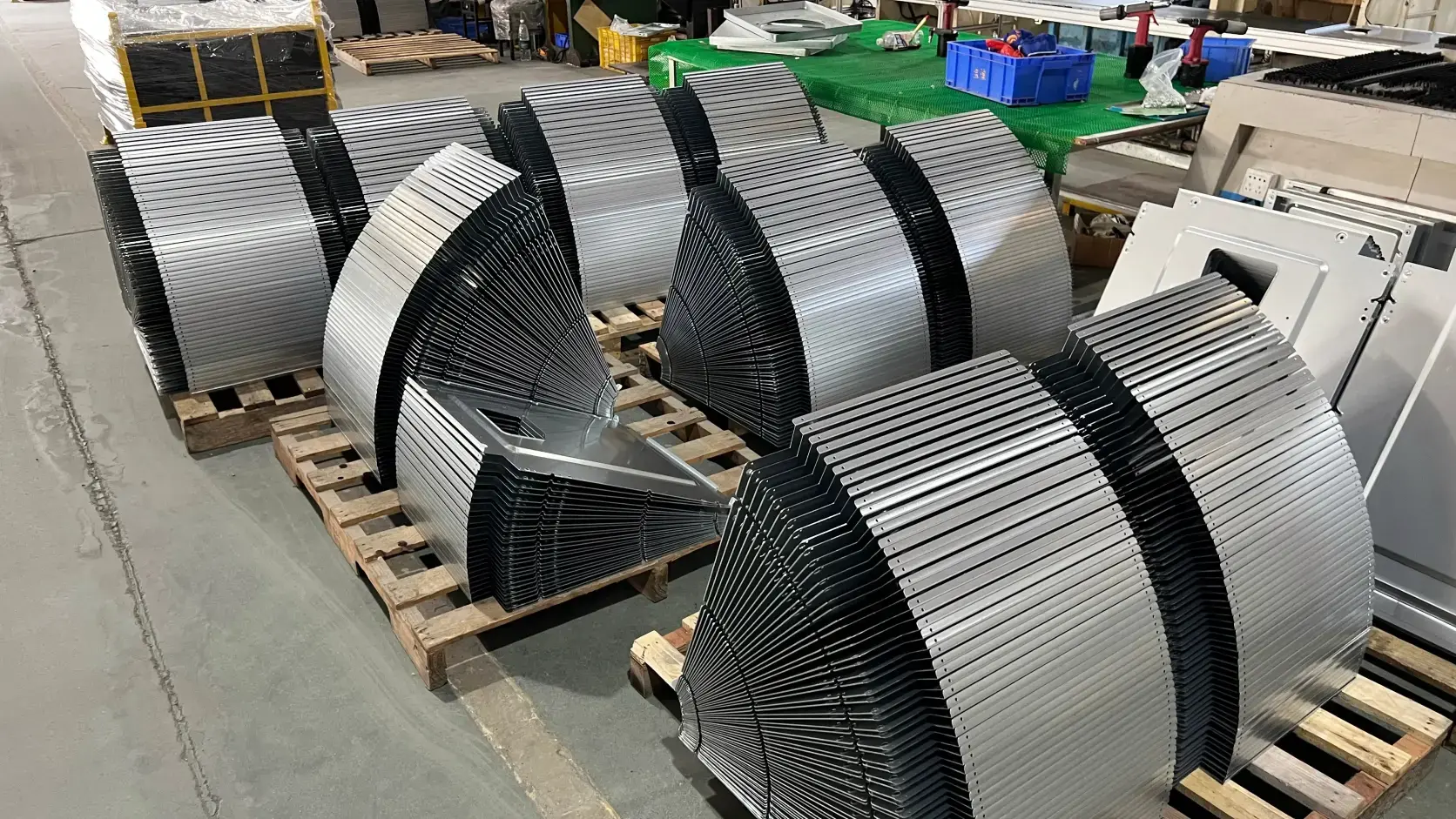

A missing mill certificate can hold up a shipment of sheet metal parts for days. In some cases, it can let non-conforming material reach your assembly line before anyone notices the problem. The document itself is not complicated — but the consequences of treating it as optional are.
What Is a Mill Certificate?
A mill certificate is a document issued by a raw material producer — typically a steel mill, aluminum smelter, or copper refinery — that reports the chemical composition, mechanical properties, and test results for a specific batch of metal. It serves as the producer’s formal declaration that the material meets the requirements of a given standard or purchase order.
The terms mill test certificate (MTC), mill test report (MTR), and mill cert all refer to the same document. “Mill” means the producing mill — the facility that manufactured the raw material, not the downstream fabricator. The certificate travels with the material from the mill to a service center, then to a fabricator, and finally to the end buyer.
What Information Should a Mill Certificate Contain?
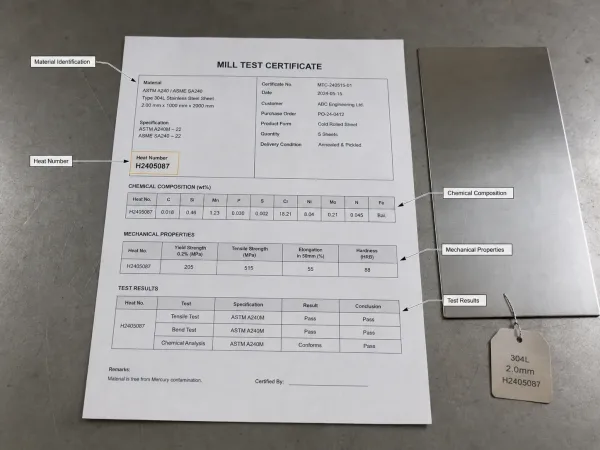
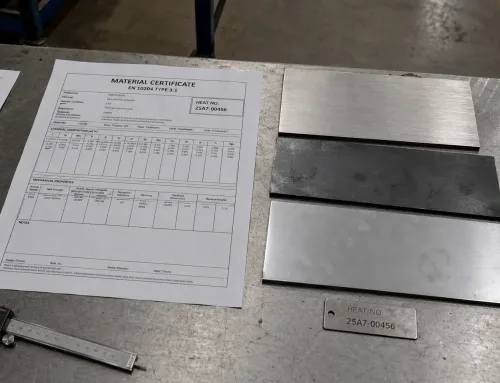
A complete mill certificate includes material identification, chemistry, mechanical properties, heat number, and test results.
A complete mill certificate includes several distinct data fields. Each serves a different verification purpose, so using an MTR review checklist helps prevent gaps in your quality records.
Material Identification
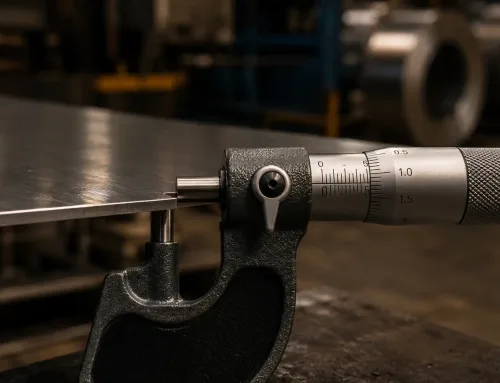
The certificate must state the material grade (e.g., AISI 304, ASTM A36, 6061-T6), the product form (sheet, plate, bar), the material specification and applicable standard (e.g., ASTM A240, EN 10088-2), and the nominal dimensions. This section confirms the material matches what your drawing specifies.
Chemical Composition
The certificate reports the weight percentage of each element in the alloy — carbon, chromium, nickel, manganese, and others depending on the grade. For AISI 304 stainless steel per ASTM A240, carbon must not exceed 0.08%, chromium ranges from 18.0% to 20.0%, and nickel from 8.0% to 10.5%. These values confirm the alloy is within specification and help detect material mix-ups.
Mechanical Properties
Typical results include tensile strength, yield strength, elongation, and hardness. For sheet metal parts, these values affect formability, weld behavior, and the part’s ability to handle service loads. A certificate with only chemical composition and no mechanical data is incomplete.
Heat Number
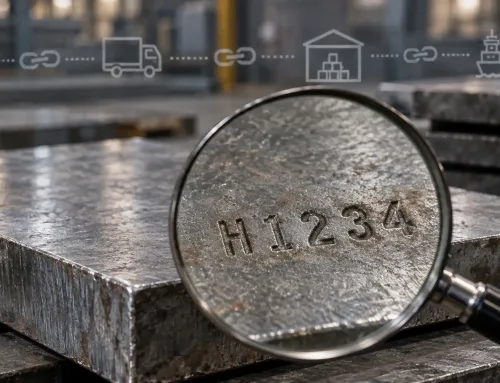
The heat number — sometimes called the heat code or melt number — is a unique identifier assigned to a specific batch of molten metal during production. It is the most important traceability element on the certificate. If a defect is discovered later, the heat number lets you trace the material back to its exact production batch and identify every other part made from the same heat.
Testing and Inspection Results
This section records the tests performed (tensile, hardness, impact, dimensional), the test method standard (e.g., ASTM E8 for tensile testing), and the measured results. Some certificates also include non-destructive testing such as ultrasonic examination when required by the order.
EN 10204 Certificate Types — What 2.2, 3.1, and 3.2 Mean
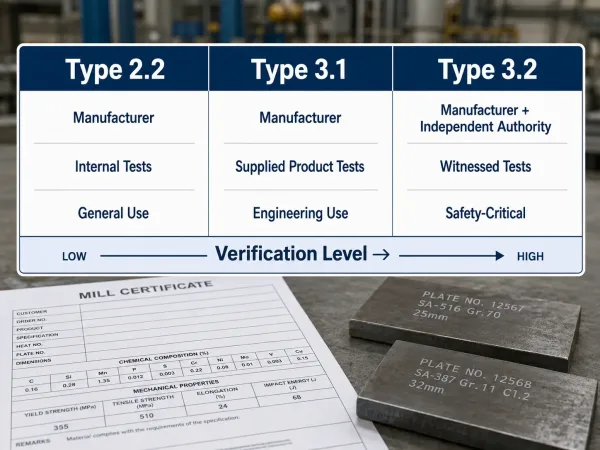
EN 10204 certificate types differ in test data and the level of independent verification.
Not all mill certificates carry the same level of verification. The European standard EN 10204 defines certificate types with different levels of independence between the issuer and the test data. Understanding these types is essential for specifying the right level of material verification on your purchase orders.
Type 2.2 is a declaration by the manufacturer that the products comply with the order requirements. The test results are based on the manufacturer’s internal testing with no independent verification. Acceptable for general-purpose, low-risk applications.
Type 3.1 is issued by the manufacturer but based on specific inspection and testing performed on the actual products supplied. The certificate is validated by the manufacturer’s authorized inspection representative. This is the most commonly required type for structural and engineering applications.
Type 3.2 involves validation by an independent inspection authority designated by the buyer. The independent inspector witnesses or repeats the testing and co-signs the certificate. Required for pressure vessels, nuclear components, and other safety-critical applications.
| Certificate Type | Issued By | Test Data Source | Typical Application |
|---|---|---|---|
| Type 2.2 | Manufacturer | Internal tests | General-purpose, low-risk parts |
| Type 3.1 | Manufacturer | Tests on supplied products | Structural parts, sheet metal assemblies |
| Type 3.2 | Manufacturer + Independent Authority | Witnessed or repeated tests | Pressure vessels, safety-critical |
Mill Certificate vs. Material Certificate vs. Certificate of Conformance
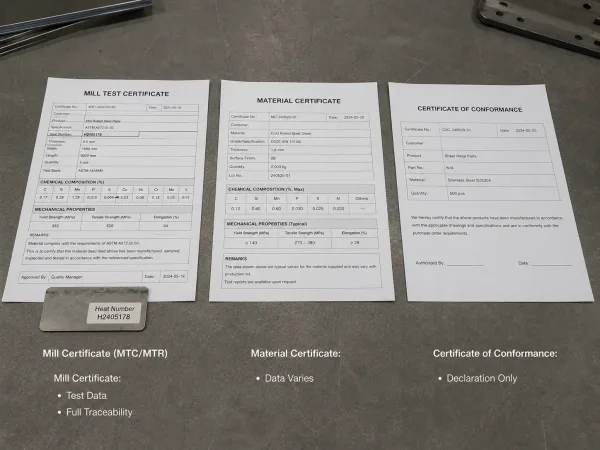
Mill certificates provide batch test data, while material certificates and certificates of conformance provide different levels of verification.
These three terms are often used interchangeably, but they are not the same document.
A mill certificate (MTC/MTR) is issued by the raw material producer and reports actual test results for a specific batch, including chemical composition, mechanical properties, and the heat number. A material certificate is a broader term that can refer to any document certifying material properties — it may come from the mill, a service center, or a third-party lab, and may or may not include test data. A certificate of conformance (CoC) is a simpler declaration that the product meets the order requirements, but typically does not include actual test data.
For sheet metal parts, the distinction matters: a CoC tells you the supplier believes the material is correct; a mill certificate proves it with data.
| Document | Issued By | Contains Test Data? | Traceability |
|---|---|---|---|
| Mill Certificate (MTC/MTR) | Raw material producer | Yes | Full batch traceability |
| Material Certificate | Mill, service center, or lab | Varies | Depends on source |
| Certificate of Conformance (CoC) | Manufacturer or supplier | Typically no | Limited |
How Mill Certificate Traceability Works in Sheet Metal Fabrication
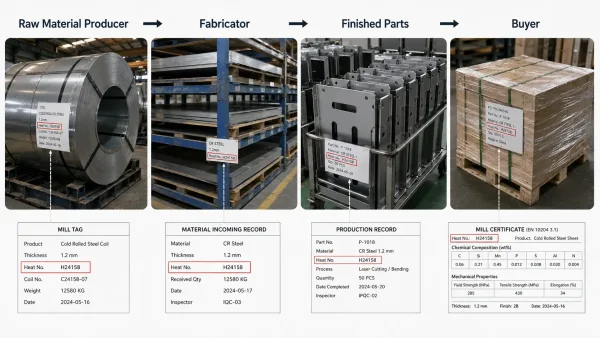
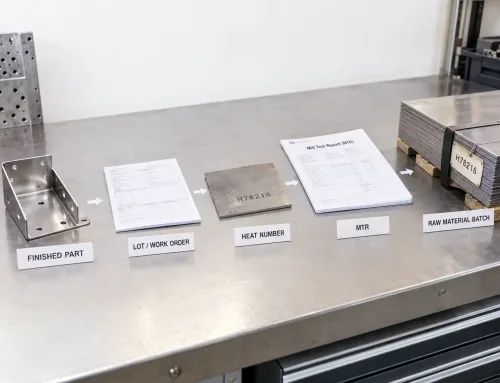
The heat number connects finished sheet metal parts to the original raw material production batch.
In sheet metal fabrication, the mill certificate does not originate at the fabrication shop. It originates at the raw material producer and becomes part of sheet metal material traceability, connecting the finished part back to its original production batch.
Stage 1 — Raw Material Producer Issues the Certificate
The steel mill or aluminum smelter generates the mill certificate at the time of production. The certificate is tied to a specific heat number and accompanies the material as it ships to a service center or fabricator. At this stage, the certificate is the producer’s guarantee that the material meets the applicable standard.
Stage 2 — Fabricator Receives and Files the Certificate
When a sheet metal shop receives raw material — steel coils, aluminum sheets, stainless plates — the incoming material is logged against its mill certificate and heat number. The fabricator does not re-test the material or issue a new certificate. The original mill certificate becomes part of the shop’s quality control and inspection records, linked to every part cut from that material.
Stage 3 — Buyer Receives the Certificate with Finished Parts
When finished parts ship, the mill certificate can be included in the delivery documentation. The buyer verifies that the material matches the drawing specification. If a defect is discovered later, the heat number allows tracing back to the production batch and identifying all affected parts.
This chain means a sheet metal fabricator cannot issue a mill certificate — only the original material producer can. The fabricator’s role is to receive, file, and transmit it.
What Happens When a Mill Certificate Is Missing or Incomplete
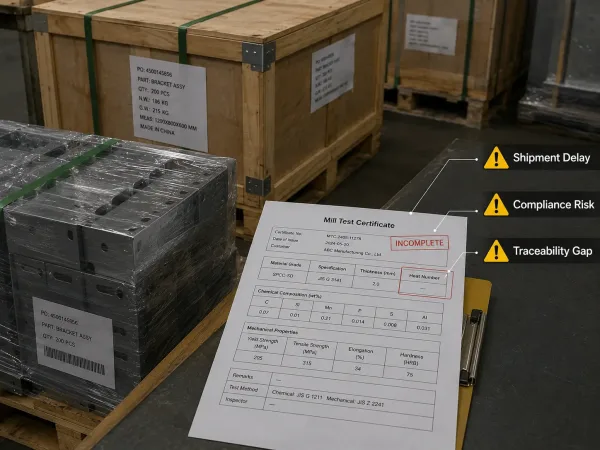
Missing mill certificates can delay shipments, create compliance problems, and break material traceability.
Shipment delays. If receiving inspection requires a mill certificate and none is provided, the shipment is held until one is located. A three-to-five-day wait for a missing certificate can disrupt assembly sequencing and downstream delivery.
Compliance risk. Industries such as aerospace, automotive, and food processing require documented material traceability. Without a mill certificate, you cannot demonstrate that the material meets the required standard. Auditors will flag this as a non-conformance.
Traceability gaps. If a material defect is discovered after parts are assembled, the heat number is the only way to scope the problem. Without the certificate, every part from that supplier becomes suspect.
How to Specify Mill Certificate Requirements on Your Purchase Order
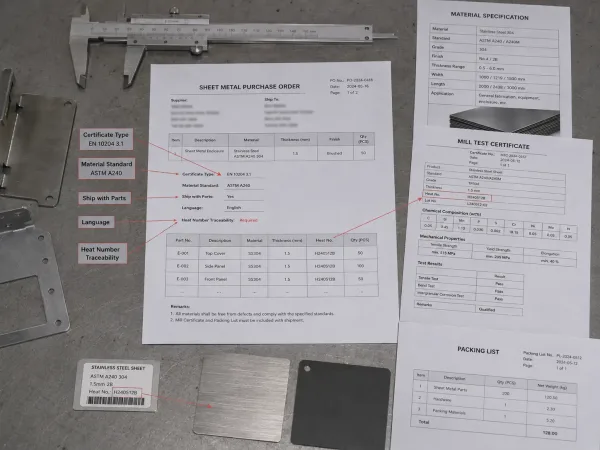
Mill certificate type, material standard, delivery documentation, and heat number traceability should be defined on the purchase order.
The most effective way to avoid disputes is to specify your requirements on the PO before production begins.
- State the certificate type. Specify EN 10204 Type 2.2, 3.1, or 3.2. Without a specified type, the supplier may provide the lowest level available.
- Reference the material standard. Include the full designation (e.g., ASTM A240, EN 10088-2) so the certificate demonstrates compliance with the correct specification.
- Require the certificate to ship with the parts. Do not accept “we will send it later.” The certificate is delivery documentation, not a follow-up item.
- Specify the language. Certificates from overseas mills may arrive in the local language by default. If your quality system requires English, state it on the PO.
- Require heat number traceability to the part. The certificate must reference the heat number, and the heat number must be traceable to the parts in the shipment — through part markings, packaging labels, or a cross-reference on the packing list.
Key Takeaways
- A mill certificate is issued by the raw material producer and reports chemical composition, mechanical properties, and the heat number for a specific batch of material.
- EN 10204 defines three certificate types — 2.2, 3.1, and 3.2 — each with a different level of verification independence. Type 3.1 is the standard expectation for most sheet metal applications.
- A mill certificate is not the same as a certificate of conformance. The former includes test data; the latter is typically a declaration only.
- The mill certificate is the only document that connects a finished sheet metal part back to its original production batch. Without it, traceability is broken.
- Specifying certificate type, standard, and delivery requirements on the PO is the most effective way to prevent disputes after parts arrive.