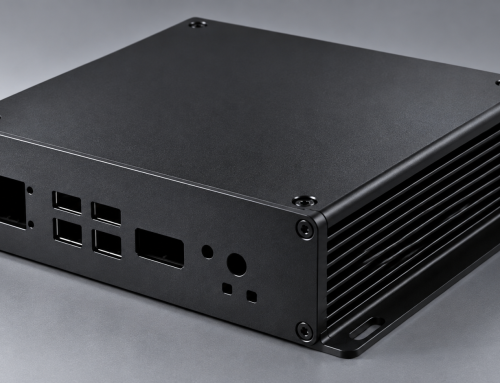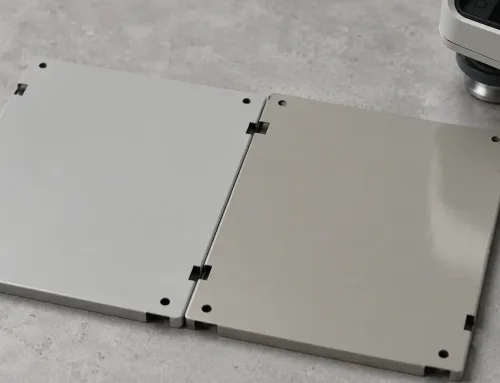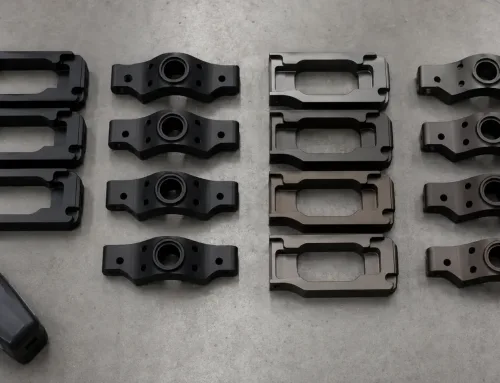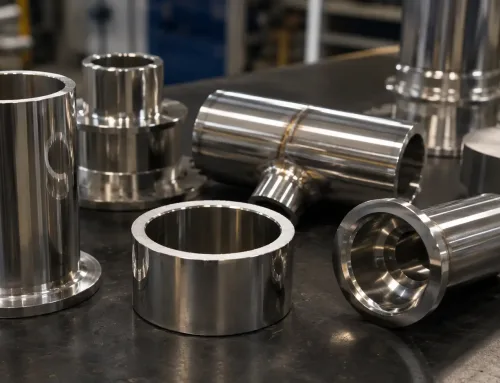

Specifying epoxy primer on a carbon steel sheet metal part sounds straightforward — add a line to the drawing, send it out for quote, and move on. In practice, that single line carries more weight than most engineers expect. The coating system you specify affects which manufacturing steps come first, whether the part can be welded after priming, how fold radii behave under stress, and whether the final assembled dimensions still hold tolerance. For a simple bracket, these may be minor concerns. For a tight-tolerance enclosure with welded seams and press-fit hardware, ignoring them can mean rework, delayed delivery, or a part that looks corroded within months of installation.
This guide explains what epoxy primer does on carbon steel sheet metal, how to specify it correctly, and what happens on the shop floor when you do.
Why Carbon Steel Sheet Metal Needs a Primer
Carbon steel corrodes. Unlike stainless steel, which forms a passive chromium oxide layer that resists further oxidation, carbon steel has no self-protecting mechanism. When exposed to moisture and oxygen — even in a warehouse or during domestic shipping — bare carbon steel develops surface rust within days. In aggressive environments (coastal, industrial, or high-humidity), corrosion progresses faster and can compromise both appearance and structural integrity.
For sheet metal parts, the risk is amplified by surface area. A flat panel or formed bracket exposes a large area of unprotected metal to the environment. Edges cut by laser or punch are particularly vulnerable because the heat-affected zone disrupts any mill scale that might otherwise offer marginal protection.
A primer serves as the first layer of a coating system. Its job is twofold: bond to the steel substrate and provide a corrosion-resistant base for subsequent coats. Without it, even a high-quality topcoat will fail prematurely because it lacks a stable foundation to adhere to.
What Epoxy Primer Actually Does on Carbon Steel
Epoxy primer is a two-component (2K) coating — a resin base mixed with a hardener (amine or polyamide curing agent) before application. Once mixed, the components cross-link to form a dense, chemically resistant film. This cross-linking is what gives epoxy its advantage over single-component primers: higher adhesion strength, better barrier performance, and greater resistance to moisture and chemicals.
On carbon steel, epoxy primer provides two core functions:
- Adhesion promotion. The epoxy film bonds mechanically and chemically to the blast-cleaned steel surface, creating a foundation that subsequent coats (epoxy intermediate, polyurethane topcoat) can adhere to without delamination.
- Barrier protection. The cured film acts as a physical barrier, blocking moisture, oxygen, and corrosive ions from reaching the steel substrate. It does not provide galvanic protection (unlike zinc-rich primers), but for C2–C4 environments per ISO 12944, barrier protection alone is often sufficient.
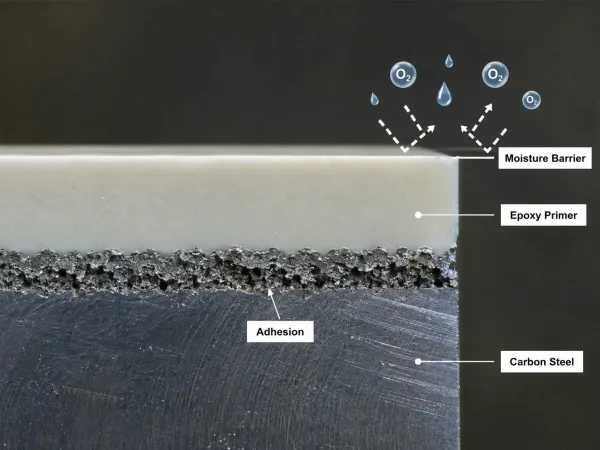
Epoxy primer bonds to prepared carbon steel and blocks moisture and corrosive contaminants.
A standard epoxy primer is applied at a dry film thickness (DFT) of 50–80 µm per coat. For most carbon steel sheet metal parts in indoor or mildly corrosive environments, a single primer coat followed by a topcoat is adequate. For outdoor or industrial exposure, a three-coat system — epoxy primer, epoxy intermediate, polyurethane topcoat — is more common, with total system DFT reaching 200–300 µm.
One distinction worth noting: 2K epoxy primer vs. single-component (1K) epoxy primer. A 2K system cures through chemical cross-linking and delivers superior performance. A 1K system cures through moisture absorption or solvent evaporation and is generally limited to light-duty or maintenance applications. For new fabrication of carbon steel sheet metal parts, 2K epoxy is the standard specification.
Surface Preparation — The Step That Determines Whether the Coating Works
Surface preparation is the single most important factor in coating performance. A well-specified epoxy primer applied over poorly prepared steel will fail within months. The coating industry consensus — supported by decades of field data — is that surface preparation accounts for roughly 60–80% of a coating system’s service life.
For carbon steel sheet metal, the minimum abrasive blasting surface preparation standard for epoxy primer is Sa 2½ per ISO 8501-1 (equivalent to SSPC-SP10 / NACE No. 2 near-white blast). This removes mill scale, rust, old coatings, and surface contaminants, leaving a clean, angular surface profile for the primer to anchor to.
Two additional factors matter:
- Surface profile (anchor pattern). The blast-cleaned surface should have a surface roughness (Rz) of 40–70 µm (confirm against the primer product TDS). Too smooth, and the primer cannot grip. Too rough, and peaks may protrude through the film, creating weak spots where corrosion can initiate.
- Surface cleanliness. Before blasting, the steel must be free of oil, grease, and soluble salts. Solvent or detergent cleaning (per ISO 8504-1) should precede abrasive blasting. Contamination left on the surface will cause adhesion failure regardless of blast quality.
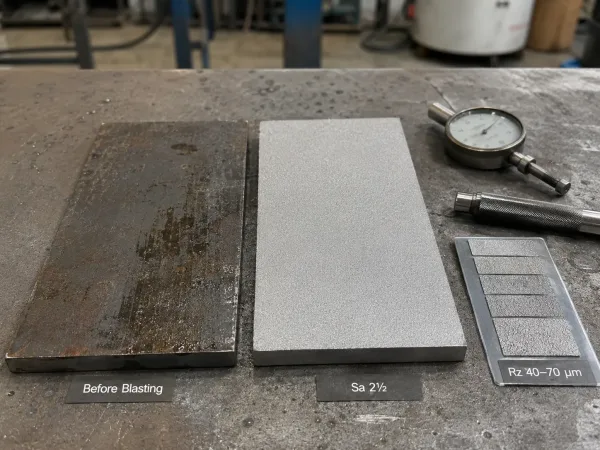
Proper abrasive blasting creates the clean and profiled surface required for reliable epoxy-primer adhesion.
Hot-rolled vs. cold-rolled carbon steel presents a practical difference. Hot-rolled sheet carries a layer of mill scale (iron oxide from the rolling process) that must be fully removed by blasting. Cold-rolled carbon steel sheet is typically smoother and free of mill scale, but may carry rolling oils that require degreasing before any surface treatment.In both cases, the goal is the same: a clean, properly profiled surface ready for primer.
After blasting, the surface should be primed as soon as possible — ideally within the same shift. Flash rust can begin to form on freshly blasted carbon steel within hours in humid conditions, and re-blasting adds cost and delays.
Epoxy Primer vs Other Primer Types for Carbon Steel
Epoxy primer is the most common choice for carbon steel sheet metal in industrial applications, but it is not the only option. The table below compares four primer types across the factors that matter for fabricated parts:
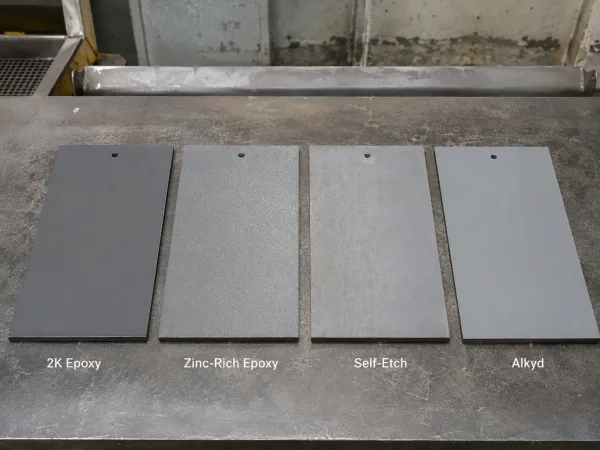
Different primer systems provide different levels of adhesion, corrosion protection, and environmental resistance.
| Factor | Epoxy Primer (2K) | Zinc-Rich Epoxy | Self-Etch / Wash Primer | Alkyd Primer |
|---|---|---|---|---|
| Primary function | Barrier + adhesion | Galvanic + barrier | Chemical etch + adhesion | Barrier (basic) |
| Corrosion protection | Good (C2–C4) | Excellent (C4–CX) | Light (C1–C2) | Light (C2) |
| Chemical resistance | High | High | Low | Low |
| Typical DFT | 50–80 µm | 60–80 µm | 8–15 µm | 40–60 µm |
| Best for | General industrial carbon steel | Heavy-duty outdoor, marine, buried | Light-gauge, non-structural | Budget, indoor, light exposure |
| Limitation | Not for immersion or CX without intermediate coat | Higher cost; topcoat required | Insufficient for structural carbon steel | Poor chemical resistance; slow cure |
For most carbon steel sheet metal parts — brackets, enclosures, panels, frames, and structural components in C2–C4 environments — a standard 2K epoxy primer is the appropriate specification. Zinc-rich epoxy is worth specifying when the parts will be exposed to marine, coastal, or heavy industrial atmospheres (C5 or higher), or when the design life exceeds 15 years with limited maintenance access.
Self-etch primers and alkyd primers are generally not suitable for fabricated carbon steel sheet metal. Self-etch primers are designed for thin-gauge or non-structural substrates and do not provide sufficient barrier protection for industrial use. Alkyd primers cure slowly, offer limited chemical resistance, and are more common in architectural or light-duty applications.
How Specifying Epoxy Primer Affects Sheet Metal Manufacturing
This is where many engineers and buyers discover that a coating specification is not just a surface treatment decision — it is a manufacturing sequence decision. Specifying epoxy primer on a drawing changes how the shop floor plans, produces, and inspects the part.
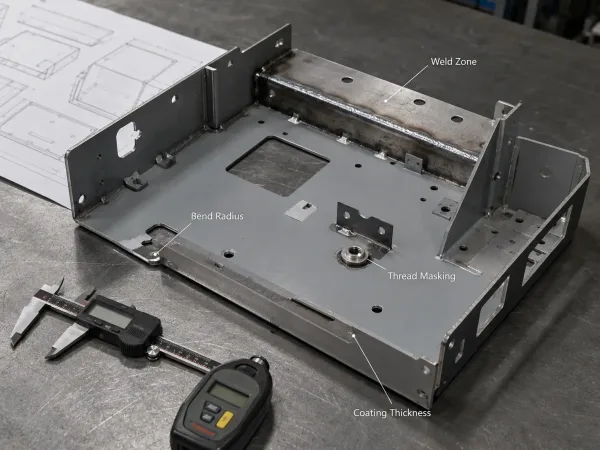
Epoxy primer affects welding zones, bend integrity, threaded features, and finished part dimensions.
Welding zones must remain uncoated
Epoxy primer burns at welding temperatures (typically above 250–300 °C). Applying primer before welding creates three problems: toxic fumes for the welder, porosity and inclusions in the weld joint, and contamination of the weld pool. For parts that require welding, the standard practice is to mask or leave unprimed a buffer zone of at least 50 mm around each weld seam. This means the coating specification must account for post-weld touch-up — and the buyer must accept that the weld zone will have a different surface finish than the primed area unless a full re-coat is performed after welding.
Bend radii affect coating integrity
When a primed sheet metal blank is bent, the coating on the outer radius stretches. If the epoxy primer’s flexibility is insufficient for the bend ratio (inner radius / material thickness), the film will crack or delaminate at the fold. For tight bends on thin sheet (e.g., 1 mm CRS with 0.5 mm inner radius), this risk is real. The solution is either to specify a primer with documented flexibility (check the TDS for mandrel bend test results), or to apply primer after forming — which changes the manufacturing sequence and may increase cost.
Film thickness adds to part dimensions
A coat of epoxy primer at 50–80 µm DFT adds that thickness to each surface. On a sheet metal part with two primed faces, the total dimensional increase is 100–160 µm (0.10–0.16 mm). For most parts, this is negligible. For press-fit interfaces, gasket surfaces, or assemblies with tight clearance requirements, it may not be. If a part has a critical mating dimension, the sheet metal surface requirements on the drawing should specify whether the tolerance applies before or after coating.
Threading and fastener compatibility
Primer inside a threaded hole can interfere with fastener engagement, increasing torque and potentially causing thread damage. The standard practice is to mask or ream threaded holes after priming, or to apply primer only to external surfaces. This should be noted on the drawing if it affects function.
Lead time and cost impact
Adding a primer coat to a sheet metal order is not a zero-cost, zero-time operation. The typical sequence — surface preparation (blasting) → primer application → flash-off / cure → inspection — adds 3–5 working days to the lead time for in-house coating, or longer if the coating must be outsourced to a specialist facility. For low-volume projects, the setup and minimum charge for a coating batch can make the per-part cost significant. Buyers should confirm the coating step when reviewing quotes, not after the order is placed.
How to Specify Epoxy Primer on Your Drawings and RFQs
A vague coating callout — “prime with epoxy” or “apply rust-resistant primer” — leaves too much to the manufacturer’s interpretation. The result is often the minimum-cost, minimum-performance option applied at the thinnest acceptable thickness. To get the coating system you need, use a drawing and RFQ checklist for sheet metal fabrication to specify five elements:
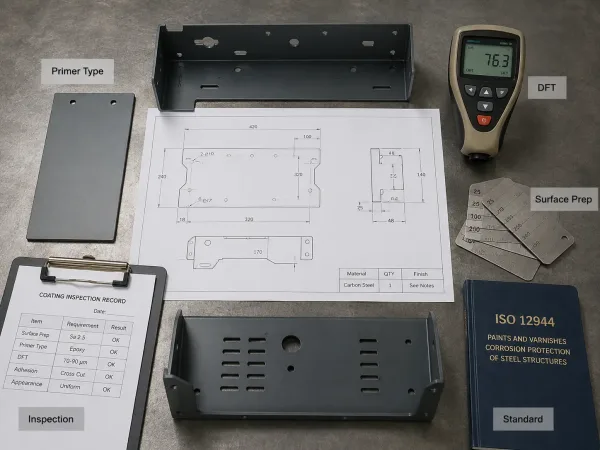
A complete coating specification defines primer type, DFT, surface preparation, inspection, and reference standard.
1. Coating type and system. State the primer chemistry, number of coats, and (if applicable) the full system. Example: “2K epoxy primer per ISO 12944-5, followed by polyurethane topcoat for C4 environment.”
2. Dry film thickness (DFT). Specify the acceptable range per coat. Example: “Epoxy primer: 50–75 µm DFT per coat.” If a total system DFT is required, state it: “Total system DFT: 200–250 µm.”
3. Surface preparation standard. Reference the blast-cleanliness standard and surface profile. Example: “Abrasive blast to Sa 2½ per ISO 8501-1, surface profile Rz 40–70 µm.”
4. Inspection and acceptance criteria. Define how the coating will be verified. Common methods include:
- DFT measurement per ISO 2808 (magnetic gauge for steel substrates)
- Adhesion test per ISO 2409 (cross-cut test, rating ≤ 1 for acceptable adhesion)
- Visual inspection for runs, sags, pinholes, and holidays
5. Reference standard. Cite the governing standard for the coating system. ISO 12944 is the most widely recognized international standard for corrosion protection of steel structures by protective paint systems. SSPC and NACE standards are common in North American specifications.
A complete coating callout on a drawing might read:
“2K epoxy primer, 50–75 µm DFT, applied over Sa 2½ blast-cleaned surface (Rz 40–70 µm) per ISO 8501-1. DFT verified per ISO 2808. Adhesion per ISO 2409, rating ≤ 1. Coating system per ISO 12944-5, C4 environment, high durability.”
This level of detail removes ambiguity and ensures the manufacturer quotes and produces to the correct standard.
Key Takeaways
- Carbon steel corrodes without protection. Epoxy primer is the standard first layer of a coating system for fabricated carbon steel sheet metal parts in C2–C4 environments.
- Surface preparation determines coating life. Specify abrasive blasting to Sa 2½ (ISO 8501-1) with a surface profile of Rz 40–70 µm. No amount of high-quality primer compensates for poor prep.
- 2K epoxy is the baseline for new fabrication. Single-component primers, self-etch primers, and alkyd primers are not appropriate substitutes for structural carbon steel parts.
- Coating specifications are manufacturing specifications. Specifying epoxy primer affects the production sequence — it determines what gets welded first, how bends behave, whether threads need reaming, and how many days the order takes to ship.
- Spell it out on the drawing. A complete callout — coating type, DFT, surface prep, inspection method, reference standard — prevents misinterpretation and ensures the part arrives coated to your actual requirements, not the manufacturer’s default.