
You have added “matte finish” to a drawing callout. The supplier responds asking for a surface roughness value. Now you need to decide: what Ra range actually qualifies as matte, and which manufacturing process will get you there?
Matte finish describes a surface with low specular reflectivity — light scatters broadly rather than bouncing back at a single angle. Unlike a mirror-polished or high-gloss surface, a matte surface diffuses light, producing a uniform, non-reflective appearance. The term is widely understood in manufacturing, but it is not self-specifying. Without a measurable parameter like surface roughness (Ra) or gloss units (GU), “matte finish” leaves too much room for interpretation.
What Is a Matte Finish?
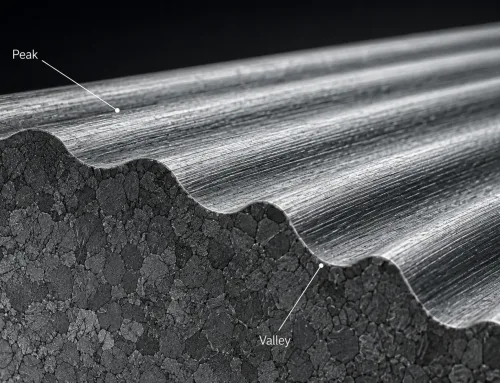
A matte finish is any surface treatment that reduces specular reflection to a low, even level. The surface micro-roughness is sufficient to scatter incident light across a wide angle rather than reflecting it back toward the viewer. This is what gives matte surfaces their characteristic soft, flat appearance.
Gloss Levels and Where Matte Falls
Sheet metal surface finishes are often described along a gloss continuum. At one end, a high-gloss surface reflects light sharply — think polished stainless steel or chrome plating. At the other end, a flat or matte surface absorbs and scatters nearly all incident light. Industry convention generally breaks the continuum into these categories:
- High gloss: >70 GU at 60° — mirror-like reflection
- Semi-gloss: 35–70 GU at 60° — noticeable reflection, softened edges
- Satin: 15–35 GU at 60° — slight sheen, diffused reflection
- Matte: <10 GU at 60° — minimal to no visible reflection
- Flat: <5 GU at 60° — virtually no reflection
Gloss units are measured with a glossmeter at a standard angle (typically 60°). The threshold between “satin” and “matte” varies by industry and application, but a surface below 10 GU at 60° is generally recognized as matte.
Matte vs. Satin vs. Glossy: What’s the Difference?
The three terms describe points on the same spectrum — they differ in how much light the surface reflects back toward the source.
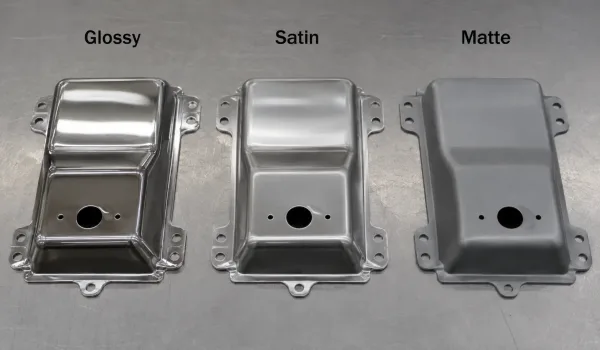
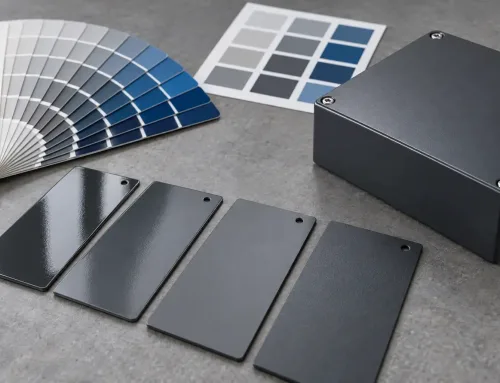
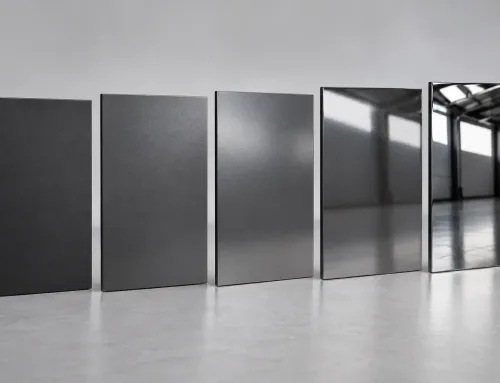
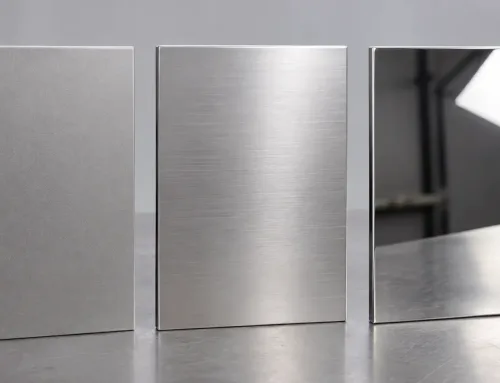
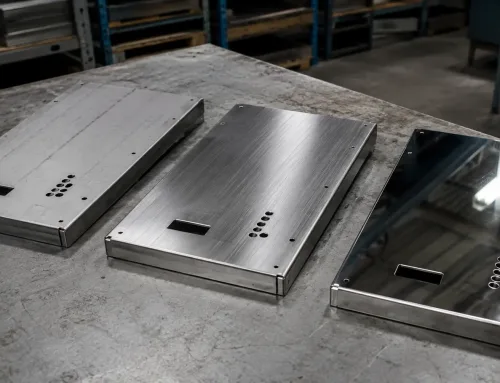
A side-by-side comparison of matte, satin, and glossy finishes showing how surface reflectivity changes visual appearance.
A glossy surface is smooth and highly reflective. Surface roughness is very low (typically Ra < 0.4 μm), and the reflection is specular — you can see a clear image in the surface. Glossy finishes are common on decorative trim, consumer electronics housings, and polished machined parts.
A satin surface sits between glossy and matte. It has a visible sheen but the reflection is softened and diffused. Satin finishes are often achieved through light bead brushing, light chemical etching, or satin anodizing. Surface roughness typically falls in the Ra 0.4–1.6 μm range.
A matte surface has minimal specular reflection. The surface texture is rough enough to scatter light broadly, producing a flat, uniform appearance with no visible image reflection. Matte finishes are achieved through bead blasting, matte powder coating, matte anodizing, or chemical etching.
Gloss Units and Visual Appearance
| Finish | Gloss Units (60°) | Visual Appearance | Typical Ra Range |
|---|---|---|---|
| High gloss | >70 GU | Mirror-like, sharp reflection | < 0.4 μm |
| Semi-gloss | 35–70 GU | Noticeable reflection, softened | 0.4–1.0 μm |
| Satin | 15–35 GU | Soft sheen, diffused light | 0.4–1.6 μm |
| Matte | <10 GU | Flat, no visible reflection | 1.6–6.3 μm |
| Flat | <5 GU | Dead flat, absorbs light | > 6.3 μm |
Keep in mind that gloss units and Ra measure different things. Gloss units quantify optical reflectivity; surface roughness (Ra) quantifies the average height variation of the surface profile. A surface can have the same Ra but different gloss levels depending on the texture pattern — a directional brushed surface at Ra 1.6 μm will look different from a blasted surface at the same Ra.
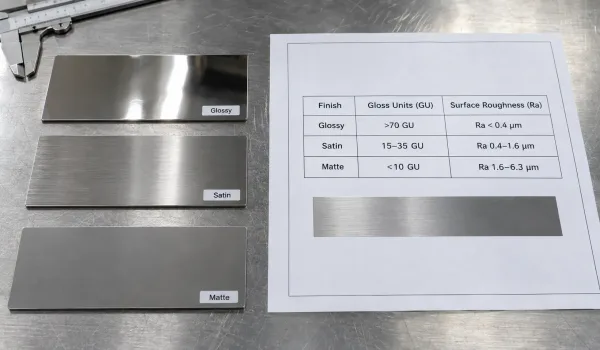
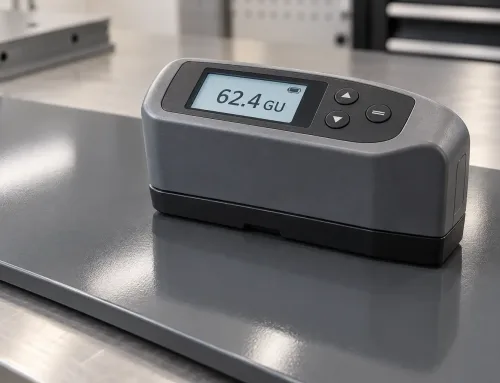
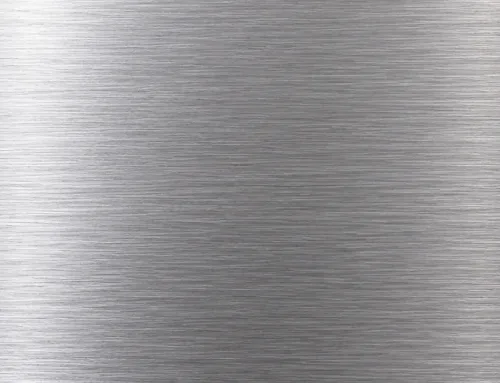
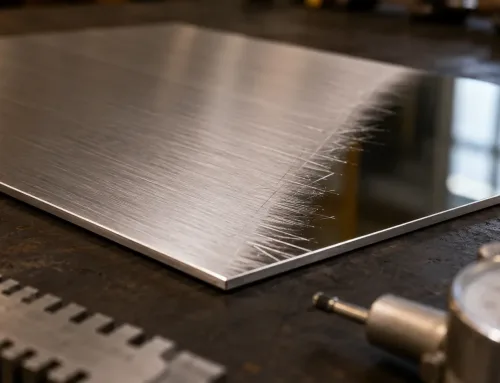
A technical reference showing how gloss units and Ra ranges relate to glossy, satin, and matte metal finishes.
What Ra Value Corresponds to a Matte Finish?
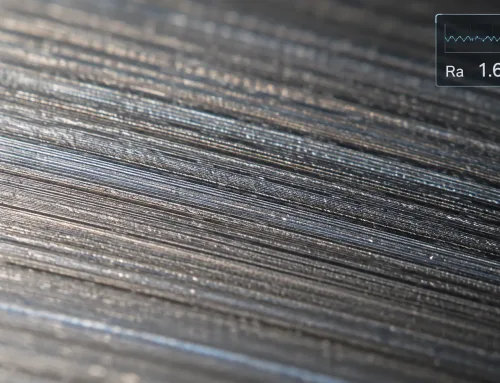
There is no single Ra value that defines “matte.” The relationship between Ra and visual appearance depends on the manufacturing process, material, and surface texture pattern. However, most matte surfaces produced through common manufacturing processes fall within a predictable range.
As a general reference:
- Bead-blasted matte: Ra 1.6–6.3 μm — the most common matte finish on sheet metal and machined parts
- Matte powder coating: Ra 1.6–3.2 μm (surface profile of the cured coating)
- Matte anodizing: Ra 0.8–3.2 μm (depends on the pre-treatment etch)
- Chemical matte etch: Ra 0.8–1.6 μm — finer matte, often on aluminum
These ranges are approximate. A blasted surface at Ra 3.2 μm on stainless steel will appear more matte than the same Ra value on aluminum, because the material’s reflectivity affects the perceived gloss. For critical applications, specify both the Ra value and the gloss unit requirement to eliminate ambiguity.
How to Achieve Matte Finish on Sheet Metal and Machined Parts
The manufacturing process you choose affects the surface texture, appearance consistency, cost, and material compatibility. Here are the four most common methods for producing a matte finish on metal parts.
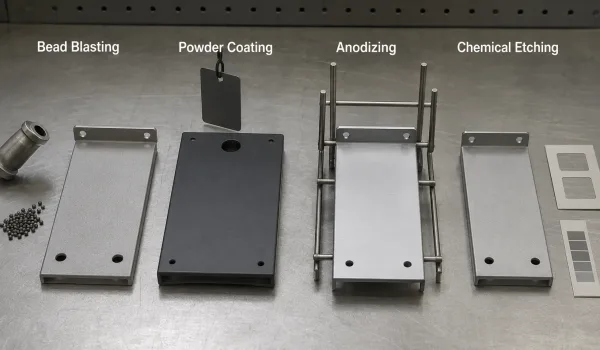
A comparison of bead blasting, matte powder coating, anodizing, and chemical etching used to create matte finishes on metal parts.
Bead Blasting
Bead blasting (also called sandblasting or abrasive blasting) propels fine media — glass beads, aluminum oxide, or ceramic particles — at the surface under compressed air. The impact creates a uniform dimpled texture that scatters light.
- Typical Ra: 1.6–6.3 μm, adjustable by media size and pressure
- Materials: Nearly all metals — steel, stainless steel, aluminum, titanium, copper
- Advantages: Fast, cost-effective, produces a consistent matte appearance across complex geometries
- Limitations: Does not add a protective coating; the bare metal surface remains exposed and may require a sealant or additional coating for corrosion protection. Blasting can also slightly reduce dimensional accuracy on tight-tolerance features.
Powder Coating (Matte Formulation)
Matte powder coating applies a dry polymer powder to the surface electrostatically, then cures it in an oven. Matte powder formulations contain texturing agents that produce a low-gloss finish without additional surface preparation.
- Typical Ra: 1.6–3.2 μm (coating surface profile)
- Materials: Steel, stainless steel, aluminum — any substrate that can withstand curing temperature (typically 160–200°C)
- Advantages: Combines matte appearance with corrosion protection and abrasion resistance in a single step. Wide color selection.
- Limitations: Adds a coating thickness of 60–120 μm, which affects dimensional tolerances. Not suitable for parts with tight assembly fits. Edges and weld seams may show coating inconsistencies.
Anodizing (Matte / Satin Anodize)
The matte anodizing process grows a controlled oxide layer on aluminum through an electrochemical process. A matte finish is achieved by etching the surface before or during anodizing — either through chemical etching (alkaline bath) or by adjusting the anodizing parameters.
- Typical Ra: 0.8–3.2 μm, depending on etch duration and alloy
- Materials: Aluminum alloys only (6061, 5052, 7075, etc.)
- Advantages: Hard, wear-resistant surface; excellent corrosion protection; maintains dimensional accuracy better than powder coating because the oxide layer is thinner (5–25 μm for Type II)
- Limitations: Aluminum only. Color consistency can vary between alloy batches and heat treatment states. Matte anodizing on 7075 may produce a different visual result than on 6061.
Chemical Etching / Conversion Coating
Chemical etching uses acidic or alkaline solutions to selectively dissolve the surface, creating a micro-rough texture. Conversion coatings (such as chromate or phosphate) can also produce a matte appearance while adding corrosion resistance.
- Typical Ra: 0.8–1.6 μm
- Materials: Aluminum, steel, zinc alloys
- Advantages: Can be applied to complex geometries without mechanical contact. Good for parts that cannot tolerate blasting forces (thin walls, delicate features).
- Limitations: Chemical process requires waste treatment and environmental compliance. The matte effect is subtle — more of a satin-to-matte range — and less uniform than blasting on large flat surfaces.
How to Specify Matte Finish on Engineering Drawings
A drawing callout that says only “matte finish” is ambiguous. Different suppliers may interpret it differently, leading to inconsistent parts or delays from clarification requests. Specify matte finish using measurable parameters.
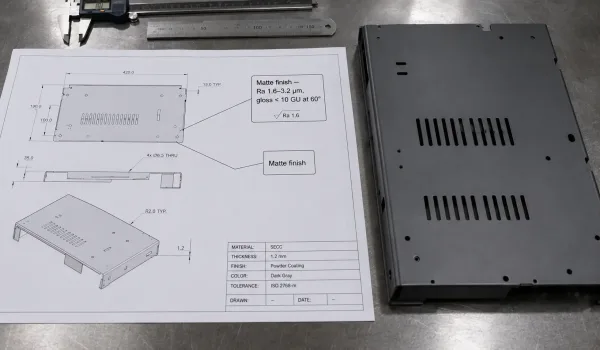
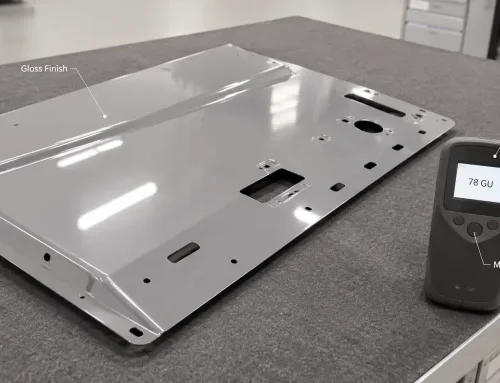
An engineering drawing showing how to specify a matte finish using Ra and gloss unit requirements.
Using Ra Values
The most precise approach is to call out the surface roughness directly:
- Format: Ra X.X μm (or Ra X μin) with a surface roughness symbol per ISO 1302 or ASME Y14.36
- Example: Ra 3.2 μm (√ symbol) on all exterior surfaces
- Why it works: Ra is a universally understood parameter. Any qualified manufacturer can measure and verify it.
However, Ra alone does not fully describe a matte appearance. Two surfaces with the same Ra can look different if the texture patterns differ (directional vs. isotropic).
Using Gloss Units
For appearance-critical parts, define measurable acceptance criteria by adding a gloss unit requirement alongside the Ra value:
- Format: “Matte finish — Ra 1.6–3.2 μm, gloss < 10 GU at 60°”
- Why it works: This defines both the surface texture and the optical result. It prevents the case where a surface meets the Ra spec but does not look matte.
Common Annotation Mistakes
- Specifying only “matte finish” with no Ra or GU value — leaves the interpretation to the supplier
- Specifying a very tight Ra range (e.g., Ra 1.6 ± 0.2 μm) — may not be achievable with all matte processes, especially bead blasting
- Not specifying the measurement location — Ra can vary across a part, especially near edges, welds, or formed areas
- Confusing matte with satin — if you want no visible sheen, specify Ra > 1.6 μm and < 10 GU; if a slight sheen is acceptable, specify Ra 0.8–1.6 μm
When Should You Choose a Matte Finish?
Matte finishes are a practical choice when the part needs to reduce glare, hide surface imperfections, or improve coating adhesion. Common applications include:
- Enclosures and housings — reduces glare in lighting-sensitive environments (medical devices, industrial control panels, military equipment)
- Outdoor equipment — matte surfaces show fewer water spots and fingerprints than glossy surfaces
- Parts that will be painted or powder coated — a matte base surface improves mechanical adhesion of subsequent coatings
- Consumer-facing products — matte finishes convey a premium, understated aesthetic common in electronics, appliances, and automotive trim
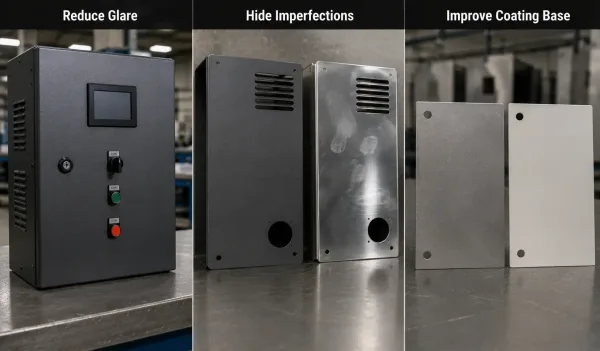
Typical applications where matte finish is chosen to reduce glare, hide marks, or support coating performance.
If the part requires a reflective surface (mirror, optical housing, decorative chrome), matte is the wrong choice. If the part is a sealing surface or requires low friction for moving contact, a matte texture may increase friction or prevent proper sealing — consult the mating part requirements before specifying.
Limitations and Trade-offs of Matte Finish
Matte finishes are not without trade-offs:
- Harder to clean — the micro-rough texture that produces the matte appearance also traps dirt, oils, and fingerprints more readily than a smooth glossy surface. In food-contact or cleanroom applications, this may be a concern.
- Not all processes produce the same result — bead blasting creates an isotropic texture; chemical etching may leave a directional pattern. The visual appearance can differ even when Ra values are similar.
- Added cost for some processes — matte powder coating and matte anodizing may carry a slight cost premium over standard formulations, depending on the supplier’s inventory and process capabilities.
- Dimensional impact — powder coating adds 60–120 μm per side. If your part has tight assembly tolerances, account for the coating thickness in your design.