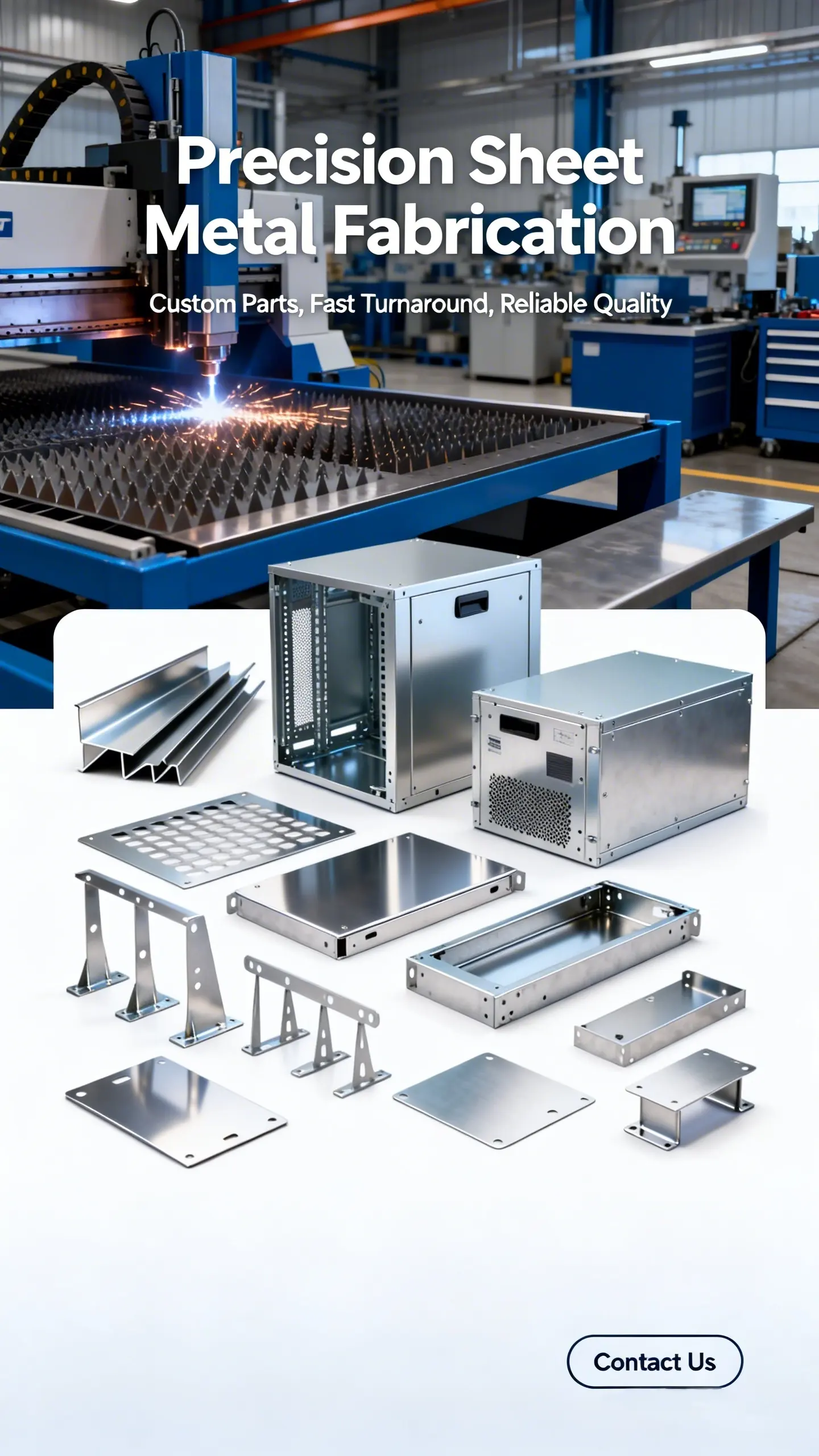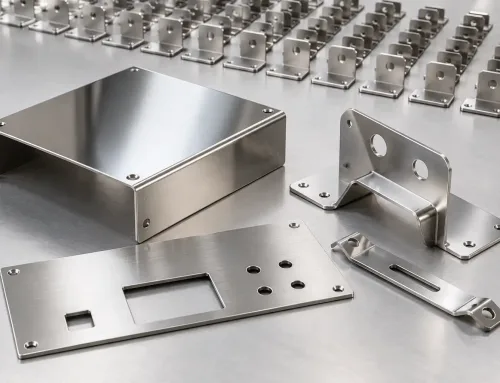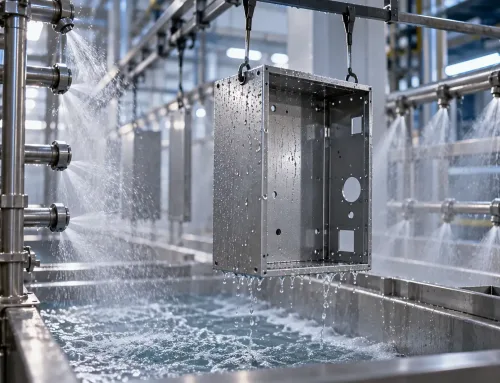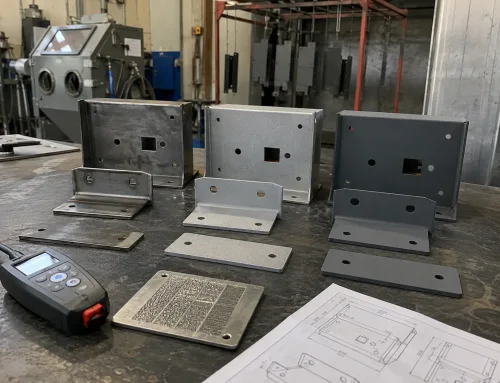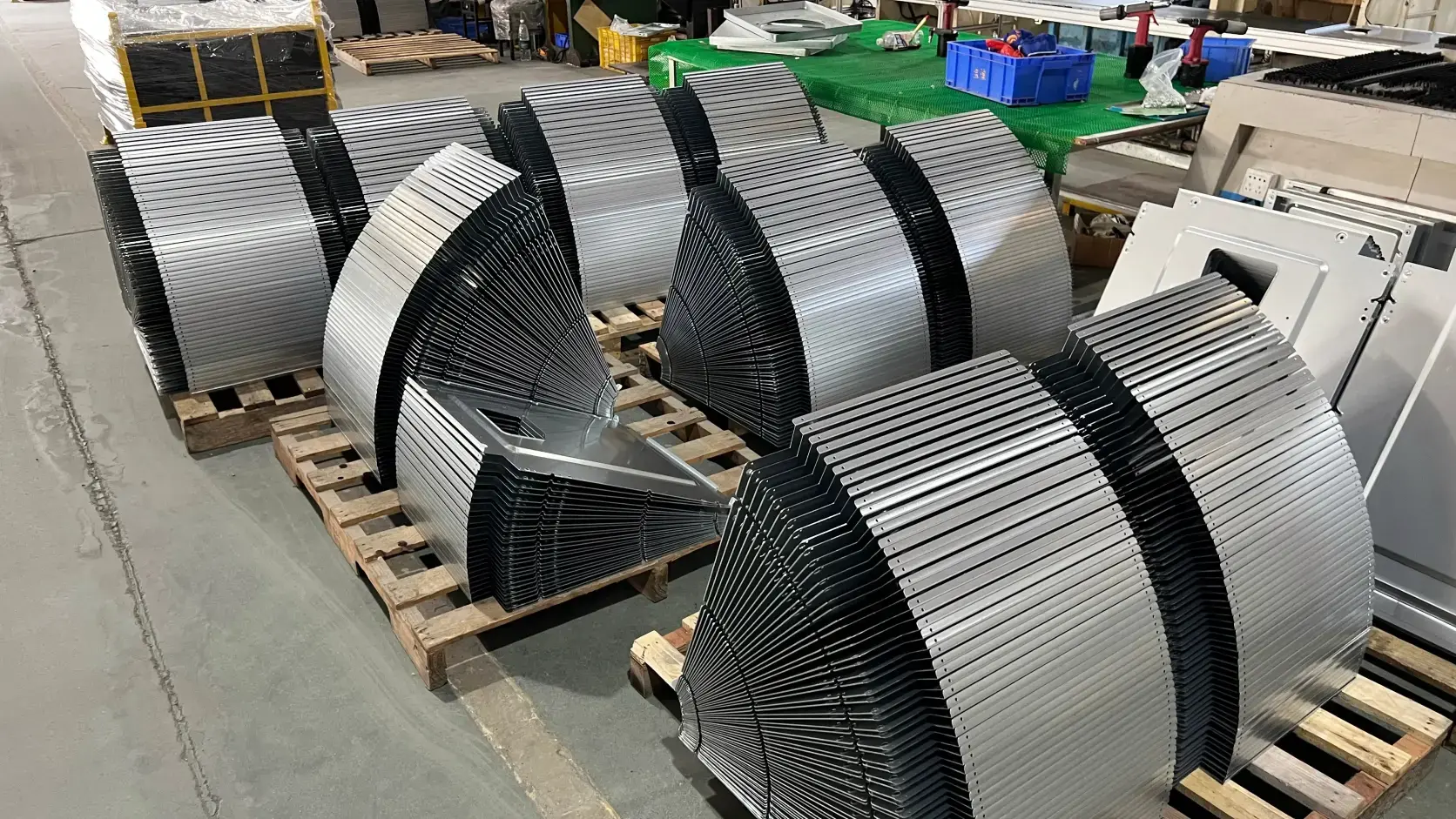

You receive a replacement sheet metal part from your supplier. The dimensions are correct, the material matches the drawing, and the holes line up. But when you hold it next to the original assembly, the color is visibly off. The gray is slightly warmer. The gloss level is different. In certain lighting, the two parts look like they came from different products.
This is one of the most common—and most preventable—problems in custom sheet metal manufacturing for replacement parts. Color mismatch on replacement parts is not usually a paint-mixing error. It is a systemic issue that starts with how the color was specified, how the substrate was prepared, and how the coating process was controlled.
This article explains why replacement sheet metal parts fail to match the original color, and what engineers and procurement teams can do to prevent it from the manufacturing side.
Why Replacement Sheet Metal Parts Rarely Match the Original Color
There are four main sources of color deviation when producing replacement sheet metal parts. Each one compounds the others, which is why even small oversights can lead to visible differences.
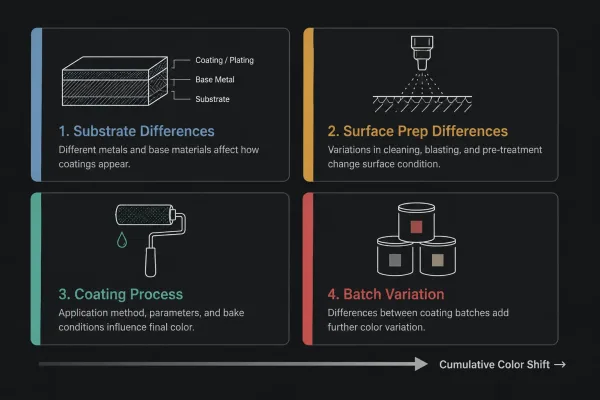
The four main sources of color deviation in replacement sheet metal parts — each one compounds the others.
Substrate differences. The original part may have been made from cold-rolled steel, while the replacement uses galvanized steel. Or the original was 1.5 mm thick and the replacement is 2.0 mm. Even when the drawing calls out the same material, surface microstructure variations between batches or suppliers affect how paint adheres and how light reflects off the finish.
Surface preparation differences. Before any coating is applied, the metal surface must be cleaned and pre-treated—through processes like degreasing, phosphating pretreatment, or chromate conversion. If the original part was phosphated and the replacement is only degreased, the paint will sit differently on the surface, producing a measurable color shift even with identical paint.
Coating process differences. Liquid paint and powder coating behave differently in terms of film thickness uniformity, color batch consistency, and gloss control. If the original was liquid-coated and the replacement is powder-coated—or even if the same process is used but with different equipment settings—the result can look noticeably different.
Batch-to-batch variation. Paint manufacturers produce color in batches. Each batch has a small but measurable deviation from the standard, expressed as ΔE (Delta E) in the CIE L*a*b* color space. A ΔE of 1.0 is generally imperceptible to the untrained eye. A ΔE of 2.0–3.0 is visible under close inspection. Many industrial paint suppliers ship product within a ΔE tolerance of 1.5–2.0, which means two parts painted from different batches may look slightly different even when everything else is identical.
When these four factors overlap, the cumulative color shift can be significant. The most reliable way to prevent this is to control each variable at the specification and sample stage—not to try to fix it after production.
How Substrate Material Affects Final Paint Appearance
The same paint formula applied to different base metals will not produce the same visual result. This is because each substrate has a different surface profile, reflectivity, and chemical interaction with the coating system.
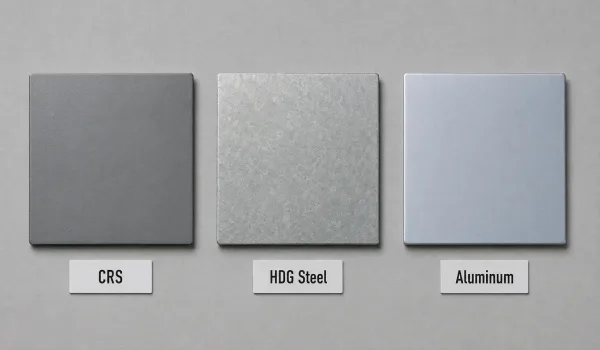
The same gray paint formula applied to three different substrates produces visibly different results due to surface energy, reflectivity, and pre-treatment variations.
Cold-Rolled Steel: Smooth Surface, Predictable Color
Cold-rolled steel (CRS) has a relatively uniform, smooth surface with low porosity. Paint adheres consistently, and the resulting finish is predictable in terms of color and gloss. CRS is the easiest substrate for color matching because the surface behaves the same way from sheet to sheet, assuming the same supplier and rolling process.
However, CRS is susceptible to flash rust if not coated promptly after surface preparation. If the replacement part sat in storage longer than the original, surface oxidation may have altered the base before coating, creating a subtle color shift.
Galvanized Steel: Zinc Layer Creates a Different Base
Galvanized steel—whether hot-dip galvanized steel (HDG) or electro-galvanized—has a zinc layer on top of the steel substrate. Zinc has different reflectivity and surface energy compared to bare steel. This means the same paint will appear slightly different in hue and brightness when applied over zinc versus over bare CRS.
Additionally, galvanized surfaces require specific pre-treatment (such as chromate passivation or a zinc-compatible primer) before topcoat application. If the original part used a primer and the replacement does not, the color will shift. If both use primers but from different chemical families, the result will also differ.
Aluminum: Oxidation and Anodizing Interfere with Color
Aluminum naturally forms a thin oxide layer that affects paint adhesion and color. If the original part was chromate-conversion-coated before painting and the replacement is simply degreased, the paint bond and appearance will be different.
Anodized aluminum presents a separate challenge. Anodizing produces a porous aluminum oxide layer that can be dyed before sealing. If the original part was anodized and sealed, and the replacement is painted instead, the color will never match because the two processes produce fundamentally different surface structures.
For painted aluminum, the key variables are the type of conversion coating, the primer (if any), and the topcoat system. These must be specified on the drawing to ensure consistency across replacement orders.
Liquid Paint vs. Powder Coating: Which Gives Better Color Consistency?
Both liquid paint and powder coating are widely used for sheet metal parts. The choice between them affects not only durability and cost but also color matching accuracy.
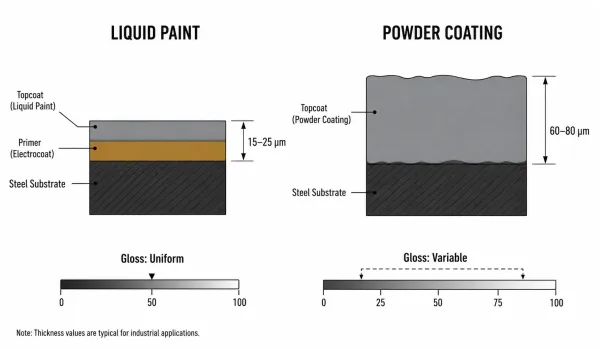
Liquid paint produces a thinner, more uniform film with better gloss control, while powder coating is thicker and more sensitive to oven and cure variations.
Liquid paint offers finer color control. Because the paint is mixed from base pigments, it can be adjusted to match a target color with high precision. Liquid systems also produce thinner, more uniform films, which reduces the risk of gloss variation across large surfaces. For applications where exact color matching is critical—such as visible consumer product enclosures or medical device housings—liquid paint is often the better choice.
Powder coating for sheet metal parts is more durable and environmentally friendly, but it has less color flexibility. Powder is manufactured as a dry blend of resin and pigment, and each production batch is a discrete run. Color adjustment between batches is possible but less precise than with liquid systems. Gloss control in powder coating depends heavily on oven temperature uniformity and cure time, both of which can vary across a production run.
| Factor | Liquid Paint | Powder Coating |
|---|---|---|
| Color precision | High — pigment can be adjusted per batch | Moderate — batch-limited |
| Gloss control | More uniform across surface | Depends on oven and cure conditions |
| Batch consistency | Good with same paint lot | Variable between powder lots |
| Film thickness control | Thin, uniform (15–25 μm typical) | Thicker (60–80 μm typical), less uniform |
| Best for color matching | Critical appearance parts | Structural or less-visible parts |
If your replacement part must match an existing assembly exactly, liquid paint is generally the safer choice—provided the original was also liquid-coated. If the original was powder-coated, the replacement should use the same process, the same powder supplier, and ideally the same production lot.
How to Specify Paint Color on Your Drawing So Manufacturers Get It Right
The single most effective way to prevent color mismatch is to specify the color correctly on the engineering drawing. Vague descriptions like “gray” or “black matte” leave too much room for interpretation. Here is what to include.
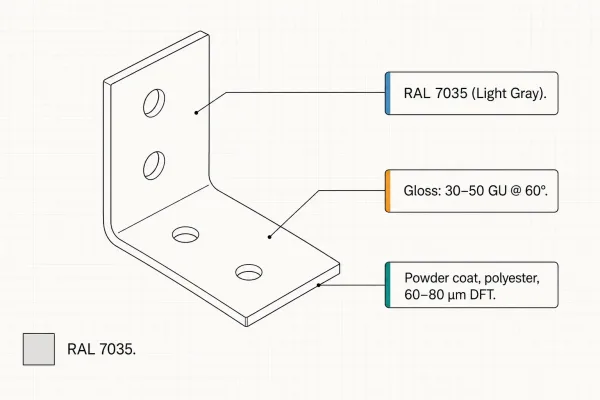
A clear drawing callout specifying color standard, gloss level, and coating process — the most effective way to prevent color mismatch on replacement parts.
Choose a Color Standard: RAL, Pantone, PMS, or NCS
Select a recognized color standard and provide the exact code. The most common standards in sheet metal manufacturing are:
- RAL Classic — Widely used in Europe and China for industrial coatings. Example: RAL 7035 (Light Gray)
- Pantone (PMS) — Common in North America and for branding-sensitive products. Example: Pantone Cool Gray 3 C
- NCS (Natural Color System) — Used in Scandinavian and architectural applications. Example: NCS S 1502-Y
Each system has different color gamuts and precision levels. RAL and Pantone are the most practical for sheet metal manufacturing because most coating suppliers can match them directly.
Always specify the full code, including any suffix (such as “C” for coated stock in Pantone). Writing “RAL gray” is not sufficient—there are over 40 gray shades in the RAL system.
Always Specify Gloss Level
Gloss is measured in gloss units (GU) at a standard angle, typically 60°. A matte finish might read 10–20 GU, while a high-gloss finish can exceed 80 GU. Two parts painted with the same RAL color but at different gloss levels will look different under the same lighting conditions.
On your drawing, specify sheet metal surface requirements such as gloss level as a range—for example, “30–50 GU at 60°” or “matte, <20 GU at 60°.” If you do not specify gloss, the manufacturer will choose a default, and it may not match the original.
State the Coating Process on the Drawing
Include the coating type and, where relevant, the specific product or system:
- “Powder coat, polyester, RAL 7035, 60–80 μm DFT”
- “Liquid two-component polyurethane, Pantone Cool Gray 3 C, 20–30 μm DFT”
- “E-coat + powder topcoat, RAL 9005, total 60–80 μm”
Specifying the process prevents the manufacturer from substituting a different coating system that may have a different color appearance, even if the pigment formula is nominally the same.
What to Confirm at the Sample Stage to Avoid Batch Color Problems
The sample stage is your last opportunity to lock in color before production. Skipping or rushing this step is the most common reason for batch-level color disputes.
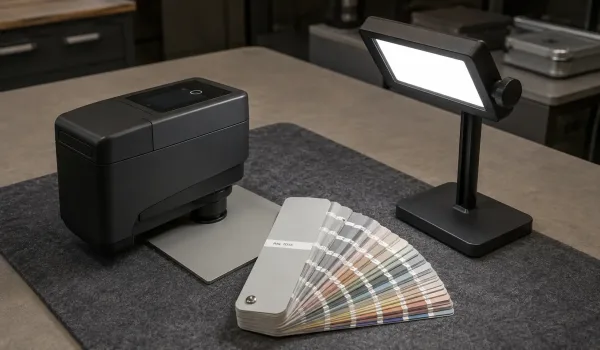
Evaluating a physical painted sample with a spectrophotometer and RAL reference under standardized D65 lighting — the gold standard for color approval at the sample stage.
Approve a physical color sample, not a digital proof. Screens, printers, and PDF color swatches are not reliable references for industrial coatings. Request a painted sample on the actual substrate, using the actual coating process. Hold this sample as the production reference.
Define a ΔE tolerance in your purchase agreement. A ΔE of ≤1.0 is tight and suitable for visible consumer products. A ΔE of ≤2.0 is standard for most industrial applications. A ΔE of ≤3.0 is acceptable for structural or non-visible parts. Agree on the value with your manufacturer before production starts.
Evaluate under standardized lighting. Color appearance changes under different light sources. Use a D65 daylight simulator (6500K) for evaluation, and avoid comparing colors under mixed or fluorescent lighting. If your product will be viewed under specific conditions (retail lighting, outdoor daylight, etc.), evaluate under those conditions.
Keep a reference sample from each production batch. If you order the same part multiple times, retain a painted sample from each batch. When placing a repeat order, send the most recent approved sample to the manufacturer as a reference. This eliminates the “drift” that occurs when color is only specified by code and not by physical comparison.
Checklist: What Color Information to Send Your Manufacturer
Before placing an order for replacement sheet metal parts, make sure your RFQ or purchase order includes the following:
- Color standard and exact code — e.g., RAL 7035, Pantone Cool Gray 3 C, NCS S 1502-Y. Do not use descriptive names alone.
- Gloss level — Specify as GU range at 60°, or describe as matte/semi-gloss/high-gloss with a target value.
- Coating process — Liquid paint (specify resin type) or powder coating (specify resin family). If the original used an E-coat primer, include that.
- Physical reference sample — Send a painted chip, a section of the original part, or a previously approved production sample. This is the most reliable color reference.
- ΔE tolerance — State the maximum acceptable color difference. If you are unsure, ΔE ≤ 2.0 is a reasonable default for industrial parts.
- Evaluation conditions — Specify the lighting standard (D65 daylight or your product’s actual viewing conditions) and viewing angle.
Providing this information upfront reduces back-and-forth communication, prevents production delays, and significantly lowers the risk of receiving parts that do not match.