
You compare black anodizing suppliers by checking certifications, comparing quotes, and approving samples. That’s the standard process — and it fails more often than most buyers admit.
The parts that arrive in week six look nothing like the sample you approved in week two. The black anodized surface finish shifts from deep matte to a slightly grey tone. Some batches pass your incoming inspection; others don’t.
You file a complaint, the supplier adjusts, and the next batch is better — until it isn’t.
The root problem isn’t that your supplier is incompetent. It’s that the criteria you used to select them don’t measure what actually matters for black anodizing consistency.
Certifications and unit prices tell you almost nothing about whether a supplier can hold the same black tone across 5,000 parts. Samples are hand-selected outliers.
What separates a supplier who delivers consistent black anodizing from one who doesn’t comes down to five dimensions most procurement checklists completely overlook.
Why Certifications and Samples Won’t Predict Your Next Batch
The Sample Trap
A sample batch is a controlled demonstration.
The supplier’s best technician runs a single rack through the process, monitors every parameter by hand, and picks the three best parts to ship to you. That’s not production.
In a real production run, the same tank processes dozens of racks per day. Bath concentration drifts. Temperature fluctuates across the tank. Racking geometry changes with part shape.
The person monitoring the line is watching three tanks simultaneously, not one.
The gap between a perfect sample and a consistent production batch is where most sourcing problems live.
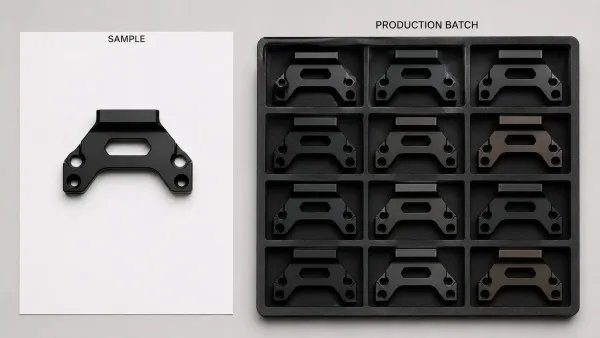
A side-by-side comparison showing a single flawless black anodized sample on the left versus a production tray of 12 parts on the right with noticeable color variation, demonstrating the gap between sample approval and real production results.
A supplier who sends you a flawless sample may still deliver 15% color variation across a 2,000-piece order — because the skills required to hand-tune a single rack are completely different from the process controls required to hold parameters steady across a full shift.
Certifications Are Table Stakes
MIL-A-8625 compliance, ISO 9001, and NADCAP accreditation are important. But they’re baseline requirements, not differentiators.
Nearly every anodizing shop that handles industrial orders will claim MIL-A-8625 Type II or Type III capability.
The certification tells you the facility has been audited — it doesn’t tell you how consistently they run their tanks on a Tuesday afternoon when they’re behind schedule.
Use certifications to filter out suppliers who clearly can’t meet your spec. Don’t use them to choose between suppliers who can.
The Five Dimensions That Actually Separate Suppliers
Before diving into each dimension, here’s the framework:
- Dyeing process control — the single biggest variable in black color consistency
- Sealing quality — the defect you can’t catch at delivery but your end customer will
- Batch-to-batch consistency — whether the supplier can repeat what they showed you in the sample
- In-house vs. outsourced anodizing — where the actual process happens and who controls it
- Equipment and bath maintenance — the unsexy infrastructure that determines process reliability
These five dimensions won’t appear on a standard RFQ evaluation sheet.
But they’re what actually predict whether your black anodized parts will look the same in month six as they did in month one.
Dyeing Process Control — The Biggest Variable in Black Consistency
The black anodizing process isn’t a single step — it involves four stages: cleaning, anodizing, dyeing, and sealing.
Of these, dyeing is where most color inconsistency originates.
The oxide layer created during anodizing is porous, and the black color comes from dye penetrating those pores. How that dye is managed determines whether your parts match across batches.
Organic vs. Metal Salt Dyes
Two dye systems dominate black anodizing, and the choice between them has direct consequences for color stability:
| Dye Type | Color Stability | UV Resistance | Cost | Typical Use |
|---|---|---|---|---|
| Organic dyes | Moderate — prone to batch variation | Lower — may fade under prolonged UV exposure | Lower | Indoor applications, consumer products |
| Metal salt dyes, typically iron or cobalt-based | High — excellent batch-to-batch repeatability | High — maintains color under outdoor exposure | Higher | Outdoor applications, industrial and military parts |
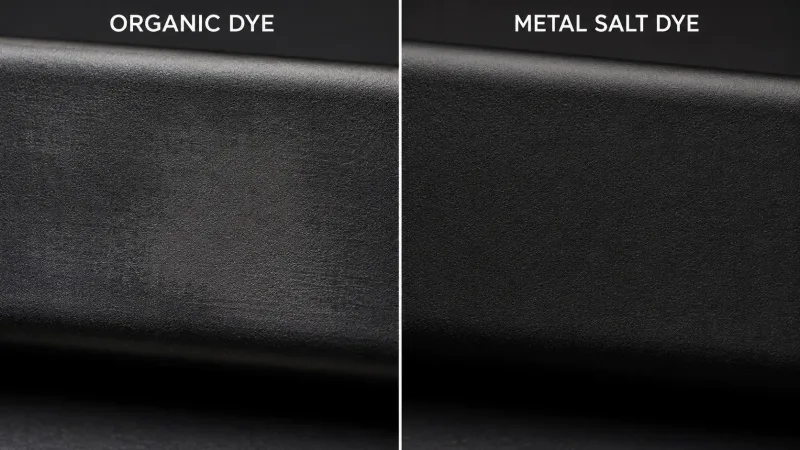
Macro close-up comparison of two black anodized aluminum surfaces — the left panel shows an organic-dyed surface with slight fading and tonal shift after UV exposure, while the right panel shows a metal-salt-dyed surface maintaining a deep, uniform black.
Organic dyes are cheaper and produce a deep, rich black.
But they’re more sensitive to bath chemistry fluctuations — small changes in pH, temperature, or dye concentration can shift the resulting color noticeably.
Metal salt dyes cost more but are far more forgiving of process variation, which is why they produce more consistent results across production batches.
If your parts will see outdoor exposure or if color matching across multiple orders is critical, metal salt dyes are the safer choice.
Most buyers never ask about dye type — and most suppliers don’t volunteer the information.
Questions to Ask About Dye Bath Management
The dye bath itself is a process variable.
Over time:
- Dye concentration drops as it’s absorbed by parts
- Contaminants accumulate
- pH drifts
How a supplier manages these variables determines batch consistency.
Ask your supplier:
- How often do you replenish or replace the dye bath?
- What concentration and pH range do you maintain, and how do you monitor it?
- Do you use the same dye system for all black anodizing orders, or do you match dye type to application?
- Can you provide color measurement data using a spectrophotometer or colorimeter for production batches, not just samples?
A supplier who can’t answer these questions clearly is running their dye bath by feel rather than by control.
That’s the single strongest predictor of color inconsistency.
Sealing Quality — The Defect You Can’t See at Delivery
Sealing is the final step of anodizing, where the porous oxide layer is closed to lock in the dye and create a barrier against corrosion.
It sounds routine.
It’s actually the step that determines whether your parts will still look right three months later.
Why Poor Sealing Shows Up Weeks Later, Not at Delivery
An improperly sealed part looks fine when it ships.
The black color is uniform, the surface is smooth, and it passes visual inspection. But within days or weeks, problems emerge:
- Color leaching — dye bleeds out of unsealed pores, creating a chalky or faded appearance
- Fingerprint staining — unsealed surfaces absorb oils from handling
- Corrosion spots — moisture penetrates the oxide layer, causing white or grey pitting
These defects are invisible at the time of delivery, which makes sealing quality one of the hardest things for buyers to evaluate.
By the time the problem surfaces, the parts are already assembled or in the field.
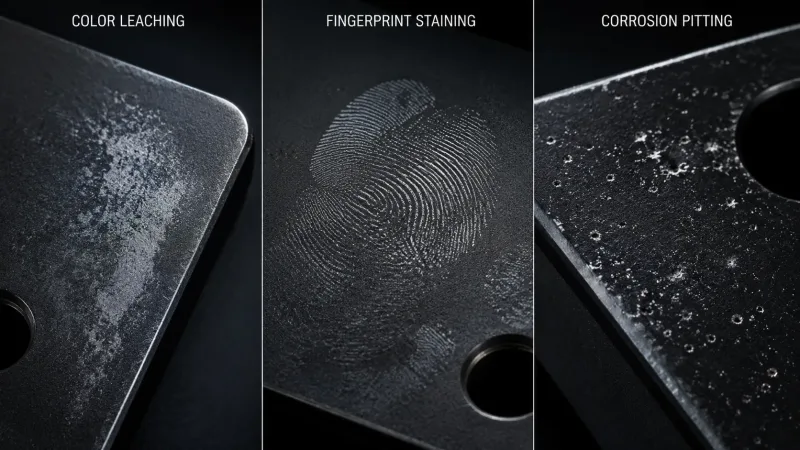
Three close-up panels showing common sealing defects on black anodized parts: color leaching with a chalky appearance, fingerprint stain marks from handling, and white/grey corrosion pitting spots.
How to Verify Sealing Quality
Two standard test methods can catch sealing problems during pre-shipment inspection, before the parts leave the supplier’s facility:
- Dye stain test (ASTM B136) — a drop of acidified dye solution is placed on the sealed surface. After a set time, the dye is wiped off. If the surface absorbs the dye and leaves a visible stain, the seal is inadequate. This is a quick, shop-floor test that any competent anodizer should be able to perform.
- Phospho-chromic acid test (ASTM B457) — a more precise method that measures the weight loss of a sealed sample after exposure to phospho-chromic acid solution. Lower weight loss indicates better sealing.
Ask your supplier:
- Which sealing test they use
- How frequently they test
- Whether they can share test records
A supplier who only relies on visual inspection for sealing quality is leaving your parts exposed to the most common form of premature failure in black anodizing.
Batch-to-Batch Consistency — How to Assess Before You Commit
This is the dimension buyers care about most — and the one they have the fewest tools to evaluate before placing a production order.
Pilot Run vs. Full Production
The most reliable way to assess batch consistency is to require a pilot run before committing to a full order.
A pilot run of 50–100 parts, produced under normal production conditions rather than as hand-monitored samples, will reveal:
- Color variation across a single rack
- Color variation between racks in the same batch
- Surface defect rate, including pitting, bare spots, and streaks
Compare these results against the original sample.
If the pilot run shows noticeable color variation, full production will be worse — not better.
Process Parameter Documentation as a Quality Signal
A mature supplier documents their process parameters for every production run:
- Bath temperature
- Current density
- Dye concentration
- pH
- Sealing time
- Sealing temperature
This isn’t paperwork for its own sake — it’s the mechanism that allows them to reproduce the same result next time.
Ask whether the supplier records process parameters for each batch and whether they can provide these records on request.
A supplier who tracks parameters can diagnose and correct drift.
A supplier who operates from memory cannot.
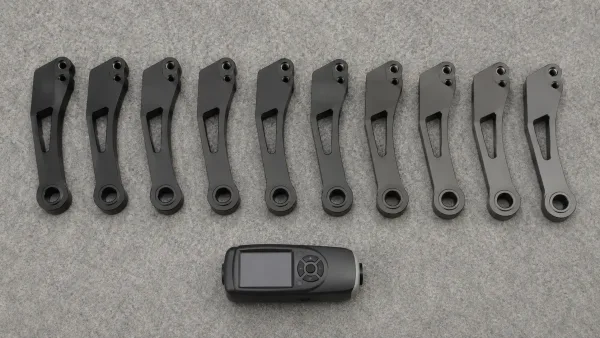
A production row of identical black anodized aluminum parts arranged in sequence, displaying a visible color gradient from deep matte black on the left to a noticeably lighter grey-black on the right, illustrating batch-to-batch color drift.
In-House vs. Outsourced Anodizing — Why It Matters for Your Supply Chain
Many CNC machining and sheet metal fabrication suppliers offer sheet metal finishing services, including anodizing — but not all of them actually perform the anodizing in-house.
Some send parts to a third-party anodizing shop and manage the process on your behalf.
This distinction matters for three reasons:
Quality Traceability
When anodizing is done in-house, the supplier controls the full process chain and can trace a defect back to a specific step.
When it’s outsourced, you’re relying on two separate quality systems that may not share detailed process data.
Communication Efficiency
If you need a color adjustment or have a question about process parameters, an in-house operation can respond immediately.
With an outsourced process, every question passes through a middleman, adding time and reducing clarity.
Schedule Control
Outsourced anodizing introduces a dependency on the third shop’s schedule.
If their tank is full or they’re behind on another order, your lead time extends — and your supplier may not have visibility into the delay until it’s already happened.
None of this means outsourced anodizing is automatically bad. Some third-party anodizing shops are excellent.
But you should know which model your supplier uses, because it changes how you evaluate their quality claims and how you manage risk.
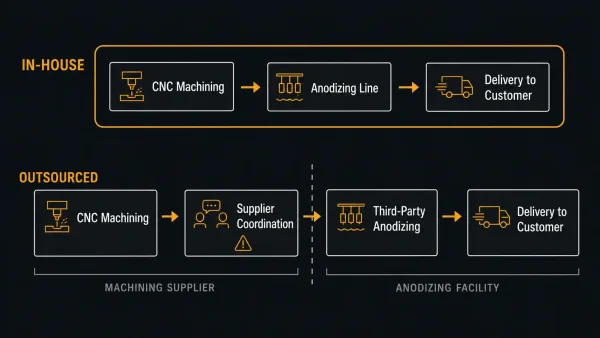
A simplified process flow diagram comparing two supply chain models — the upper path shows a direct in-house anodizing workflow from machining to anodizing to delivery, while the lower path shows an outsourced model with an additional third-party facility step, highlighting added communication layers and traceability gaps.
Equipment and Bath Maintenance — The Unsexy Indicator That Tells You Everything
An anodizing line is only as reliable as its weakest tank.
The sulfuric acid bath that creates the oxide layer, the dye tank, and the sealing tank all degrade over time:
- Acid concentration drops
- Dye accumulates contaminants
- Sealant temperature becomes uneven across the tank
How a supplier maintains their equipment is a direct indicator of process reliability.
Evaluate the following:
- Bath analysis frequency — daily titration or automated monitoring vs. periodic checks
- Temperature control — uniformity across the tank; ±1°C is excellent, while ±5°C introduces variation
- Filtration and agitation — whether particulates are removed and the solution is kept uniform
- Electrode and rectifier condition — worn electrodes create uneven current distribution, leading to thickness variation
You don’t need to audit the facility yourself, though it helps.
Ask the supplier how often they analyze and adjust their baths, and whether they can share recent bath analysis records.
A supplier who maintains detailed logs is one who takes process control seriously.
A supplier who says, “we’ve been doing this for 20 years and know our tanks,” is telling you they rely on experience rather than data — which works until the experienced person is absent.
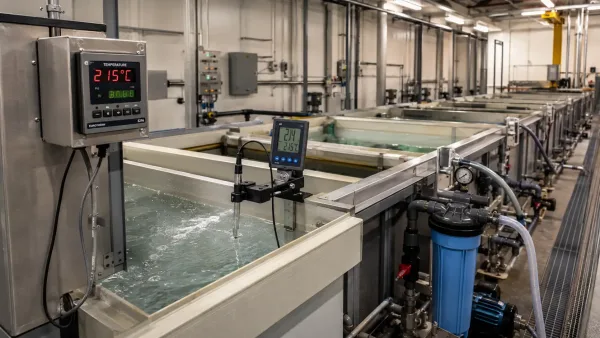
An industrial anodizing production line featuring multiple processing tanks with visible monitoring equipment — digital temperature displays, pH meters, and filtration units — representing the data-driven maintenance approach that ensures process consistency.
Black Anodizing Service Providers Worth Evaluating
The following companies are established black anodizing service providers with documented capabilities.
This list is not a ranking or endorsement — it’s a starting point for applying the evaluation framework described above.
How to Read This List
Each entry below is a manufacturing facility with its own anodizing production line — not a trading company or online quoting platform.
The list focuses on Chinese factories that handle black anodizing in-house, which gives you direct visibility into their process control and eliminates the middleman layer.
Use these profiles to shortlist candidates, then evaluate them against the five dimensions covered in this article.
| Provider | Location | Black Anodizing Capabilities | Key Certifications / Standards | Strengths | Typical Applications | Website |
|---|---|---|---|---|---|---|
| Pioneer Metal Finishing | United States (multi-site) | Type II black, Type III black hardcoat, Optical Black, Medi-Black, PTFE hardcoat | ISO 9001:2015; select sites: Nadcap, AS9100, IATF 16949 | Broadest black anodizing product line — standard black, hardcoat black, low-reflectance optical black, sterilization-resistant medical black, and PTFE-sealed hardcoat; select sites handle large parts | Aerospace, medical devices, optical equipment, automotive, industrial machinery | pioneermetal.com |
| Anoplate Corporation | Syracuse, New York, USA | Type I, IC, II, III, black hardcoat, AnoBlack EC (inorganic electrolytic black), PTFE-sealed hardcoat | ISO 9001, Nadcap Chemical Processing, ITAR; MIL, AMS, ASTM specs | Expert at selective masking and complex precision parts; inorganic electrolytic black (AnoBlack EC) suited for high-temperature, vacuum, optical, and low-outgassing environments | Aerospace, defense, optics, medical instruments, semiconductor equipment, precision electronics | anoplate.com |
| Aalberts Surface Technologies – Göppingen-Voralb | Göppingen, Germany | Black technical anodizing, colorless anodizing, black HART-COAT®, colorless hard anodizing, NUCOCOMP® | ISO 9001, IATF 16949, ISO 14001, ISO 50001; HART-COAT® to ISO 10074 | Industrial-scale batch processing with both standard and hard coat black lines; strong for automotive and precision industrial parts at volume | Automotive transmissions, valve components, pumps, brake parts, control electronics | aalberts-st.com |
| Hard Anodising Surface Treatments Ltd. | Kidderminster, United Kingdom | Type II sulfuric, Type III hard anodizing, chromic anodizing, black and color dyeing, PTFE post-treatment | Nadcap Chemical Processing, AS9100D, ISO 9001; MIL-A-8625 Type III, AMS 2469 | Engineering- and aerospace-grade hard anodizing specialist; tank capacity for parts up to ~5.5 m long; typical hard coat 25–100+ μm at 400–600 HV | Aerospace, defense, motorsport, precision engineering, large industrial components | hard-anodising.co.uk |
| E.V. Wood Anodising Ltd. | Birmingham, United Kingdom | Standard, black and color, hard anodizing, conversion coatings, multiple pretreatments | ISO 9001; hard anodizing to BS 5599:1993 | Decorative black, color, and industrial hard coat; max part length ~3 m; matte, semi-bright, and bright pretreatment options for controlled final appearance | Industrial moving parts, hydraulic components, marine parts, motorsport brakes, decorative aluminum | anodised.co.uk |
| A-Grade Anodising | Ormeau, Queensland, Australia | MIL-A-8625F Type II Class 1/2, Type III Class 1/2, black and color anodizing, marine-grade anodizing, Alodine | MIL-A-8625F Type II and III; MIL-DTL-5541F conversion coating | Flexible for small-to-mid-size parts and multi-color work; tank size ~1400 × 800 × 450 mm; publicly documented black and color samples | Racing engine parts, medical equipment, military equipment, underwater lighting, general manufacturing | agradeanodising.com.au |
Note: Always verify current certifications, capacity, and lead times directly with the factory before placing an order.
Request a manufacturing facility tour or video walkthrough of the anodizing line so you can see how the process is actually controlled.
A Practical Evaluation Checklist for Your Next RFQ
Use this checklist when requesting quotes from black anodizing suppliers.
It maps directly to the five evaluation dimensions covered in this article.
Dyeing Process
- What dye system do you use for black anodizing: organic or metal salt?
- How do you monitor and control dye bath concentration and pH?
- Can you provide spectrophotometer or colorimeter data for production batches?
Sealing Verification
- What sealing method do you use: hot water, nickel acetate, or mid-temperature seal?
- Do you perform dye stain testing under ASTM B136 or phospho-chromic acid testing under ASTM B457?
- How frequently do you test sealing quality, and can you share recent records?
Batch Consistency
- Can you provide a pilot run of 50–100 parts before committing to full production?
- Do you record process parameters such as temperature, current density, and time for each production batch?
- What is your typical color variation tolerance across a production lot?
In-House vs. Outsourced
- Do you perform anodizing in-house or outsource to a third-party facility?
- If outsourced, which facility do you use, and can I audit or visit it?
Equipment and Maintenance
- How often do you perform bath analysis, including titration and concentration checks?
- What is your tank temperature uniformity specification?
- When was your last rectifier calibration and electrode replacement?
Including these questions in your RFQ won’t just help you compare suppliers.
It will signal to the supplier that you understand the process, which tends to result in better communication and fewer surprises during production.