
Two suppliers report yield on the same batch of sheet metal brackets. One reports 96 percent. The other reports 88 percent. Both numbers are honest. One supplier counts reworked parts as good output; the other counts only parts that passed on the first try. Side by side on a scorecard, the two figures are not comparable at all.
Yield rate looks like a single simple ratio. In practice it is a family of ratios, and the answer depends on two decisions made before anyone touches a calculator: what goes into the denominator, and what counts as good in the numerator. This entry defines the term in a manufacturing context, works through the basic calculation, and shows how rework (extra processing that brings a defective part back to specification) and scrap (units rejected and not reprocessed) each change the number in different ways.
What Yield Rate Means in Manufacturing
Yield rate is the share of units that meet requirements, expressed as a percentage of the units that entered the process or order. In manufacturing quality language, it answers one question: of what we put in, how much came out good?
The term also appears in unrelated fields. College admissions uses yield for the share of admitted students who enroll, and finance uses it for investment income. Neither sense applies on a shop floor. When a quality report, a supplier scorecard, or a lot-acceptance review mentions yield rate, the manufacturing definition above is the one in force.
For buyers, the number shows up in quality reports, first-article inspection summaries, supplier scorecards, and occasionally inside quote assumptions, where a supplier’s expected yield feeds into the unit price.
How Yield Rate Is Calculated
At its simplest, yield rate is good output divided by total input:
Yield rate = (good units ÷ total units started) × 100
Two details decide whether the result means anything. The first is the denominator: input normally counts every unit that entered the process, including units later found defective, held for rework, or scrapped. The second is what “good” means — in a custom parts context, units that meet the drawing at final inspection.
Consider one lot of 100 brackets after forming and welding. At first inspection, 92 meet the drawing and 8 do not. The disposition of that lot at this moment is:
| Disposition at first inspection | Units | Counted as good output? |
|---|---|---|
| Passed | 92 | Yes |
| Failed, disposition pending | 8 | Not yet |
| Total started | 100 | — |
The first-pass result is 92 ÷ 100 = 92%. The 8 failures are not yet classified — they may be reworked or scrapped, and that decision is exactly what moves the number in the next two sections.
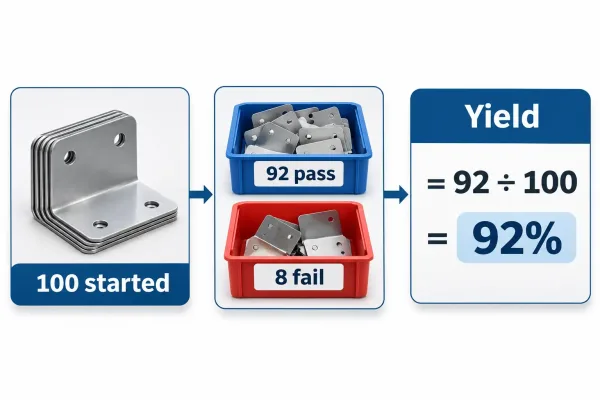
First-pass yield calculated from a 100-unit lot: 92 pass, 8 fail.
How Rework Changes the Number: First-Time Yield vs Overall Yield
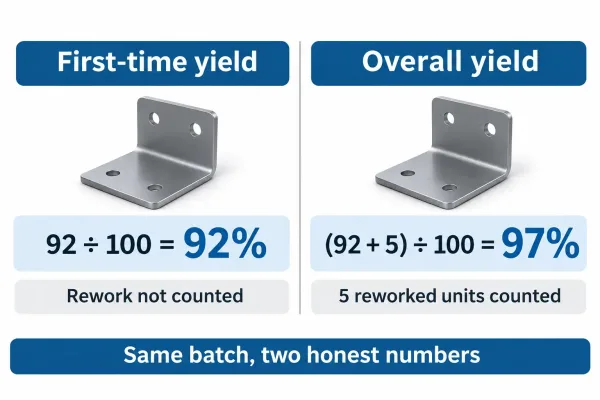
Two accounting methods describe the same production. First-time yield (FTY) counts only units that passed inspection without any rework. Overall yield counts units that eventually meet requirements after successful rework. The two numbers diverge by exactly the amount of rework that is allowed.
A Batch Counted Two Ways
Return to the 100 brackets. Of the 8 failures, 5 are reworked to full specification and pass re-inspection; 3 are beyond economic rework and are scrapped. The same production now supports two honest numbers:
| Method | Calculation on this batch | Result | What it tells you |
|---|---|---|---|
| First-time yield (FTY) | 92 ÷ 100 | 92% | Process capability without a rework safety net |
| Overall yield | (92 + 5) ÷ 100 | 97% | Good units the order actually delivers |
| Scrap | 3 units | — | Removed from every numerator |
The gap between 92% and 97% is not a discrepancy. It is the accounting cost of five reworked parts. Two suppliers can therefore report 92% and 97% on identical production and both be correct.
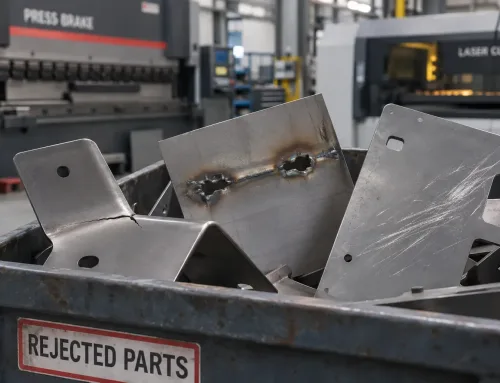
Scrapped sheet metal parts in a red bin beside a laser-cut sheet skeleton with offcuts
If a buyer compares one supplier’s FTY against another supplier’s overall yield, the comparison is meaningless. FTY is the tighter quality signal — it shows what the process achieved without a safety net. Overall yield is closer to what the order costs to fulfill, because rework consumes labor and machine time even when the part ends up conforming. Ask which method is being reported before either number enters a scorecard.
How Scrap Changes the Number
Scrap removes units from good output permanently. A scrapped unit never re-enters the numerator, so yield drops one point per scrapped unit under any accounting method. Rework keeps a part alive; scrap ends it. That is the essential difference when reading a yield figure: rework allows two different numbers to exist, while scrap depresses both numbers equally.
Scrap Is Not Material Utilization
In sheet metal, one more distinction matters. Material utilization measures how much of the raw sheet becomes parts — the offcuts and skeleton left after laser nesting are a utilization loss, not a quality loss. Those offcuts were never finished parts, so they do not belong in a part-count yield denominator. A shop can post excellent nesting utilization and poor part yield on the same job. Keeping the two ledgers apart is the only way to find out which one is actually losing money.
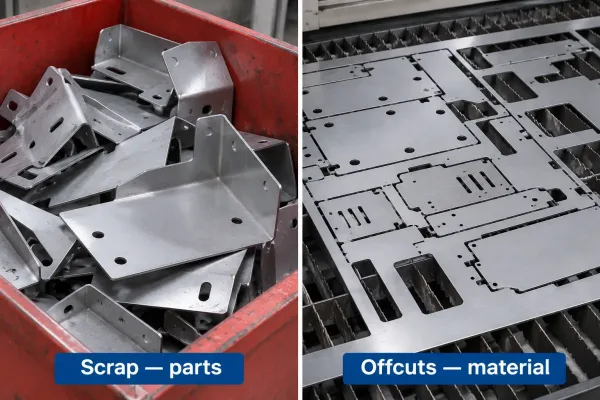
Scrapped parts and nesting offcuts belong to two different ledgers.
What Realistic Yield Looks Like in Custom Sheet Metal
Catalog production can quote annual yield in the high 90s because the same part runs for months on stable tooling. Custom sheet metal is different. Short runs, mixed materials, frequent changeovers, and first-time builds of a new design all raise variability. A single lot in the 85–98% range is ordinary; the trend across lots and the reasons behind each failure matter more than any one figure.
Why First-Article Yield Is Not Production Yield
A perfect first article proves the process can make one good part under close attention. It says little about lot 200, where brake setup has drifted, a new material heat shows different springback, or a welder is working to a revised sequence. First-article approval confirms the design and the routing; batch yield confirms that the process stays in control. Treat them as separate control points, and the gap between them stops being a surprise.
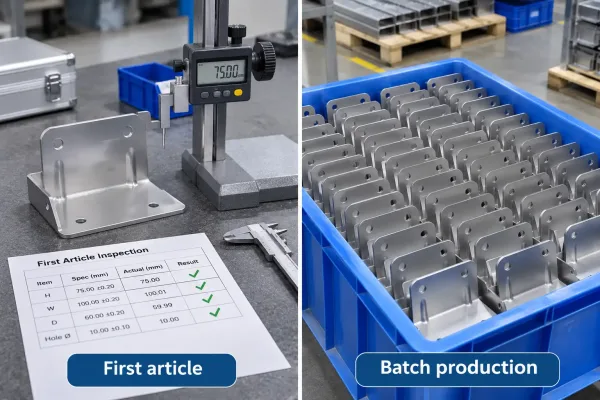
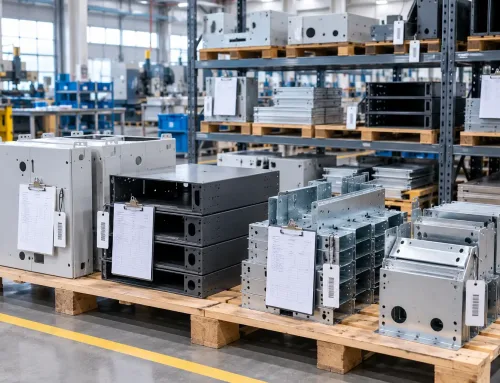
One approved first article and a full production batch are separate control points.
What Design Decisions Move the Number
Yield is not only a shop-floor variable — a large part of it is fixed on the drawing. Tolerances that approach machine capability, surface-finish callouts without inspection criteria, and critical dimensions left unmarked all raise the odds that a conforming-looking part fails at inspection. The practical rule: any requirement that cannot be clearly inspected is a requirement that can fail ambiguously. On similar parts, that rule often explains the difference between a stable 95% and a drifting 88%.
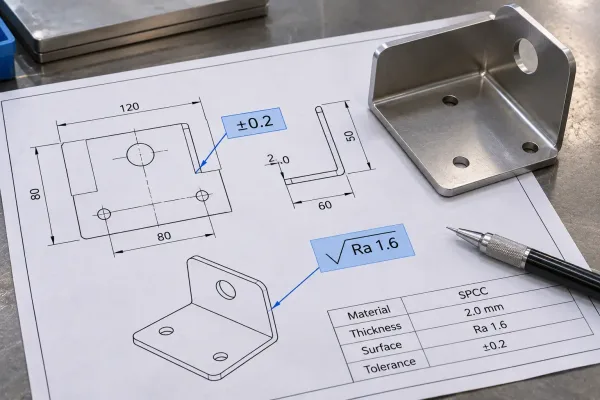
Tolerance and surface callouts on a drawing shape first-pass yield before production starts.
How to Read a Supplier’s Yield Claim
A yield percentage without a stated method is a number without a referent. Before it enters a scorecard or a comparison, four questions make two numbers comparable.
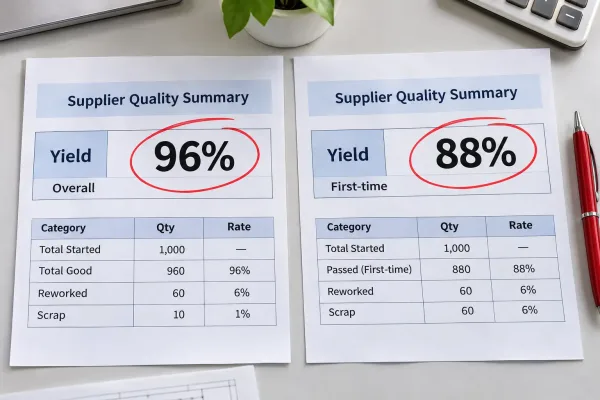
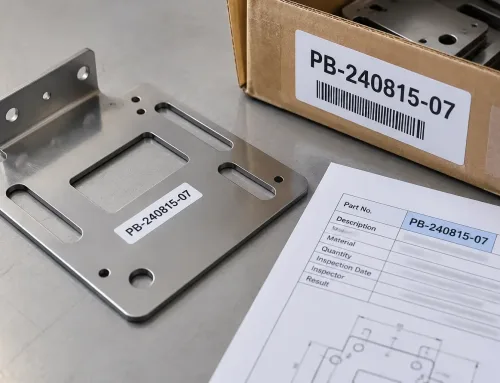
Two yield claims on one desk: each number is only valid together with its counting method.
Questions That Make Two Numbers Comparable
- Which yield? First-time or after rework?
- Which denominator? Units started, units received, or units accepted for processing?
- Over what window? One lot, one month, one part family?
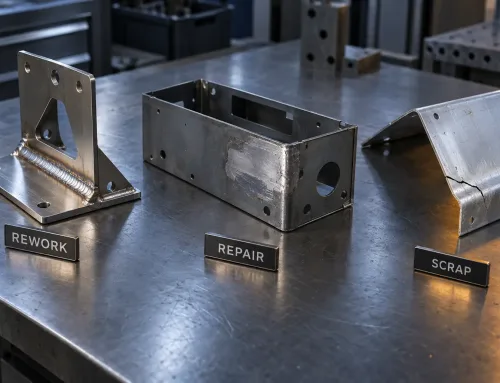
- What happens to failures? Reworked to print, repaired under deviation, or scrapped — and which of those counts as good?
Yield assumptions also sit inside quotes. A supplier assuming 90% first-pass yield on a new design prices differently than one assuming 97% on a proven part family; the gap appears either in unit price or in rework charges later. Writing the agreed yield definition, the rework and scrap disposition rules, and the reporting window into the RFQ or PO takes one paragraph and removes most arguments about whose number is right.
FAQs
Yield rate is only as useful as the definition behind it. State the denominator, state whether rework counts, state the window — and the number becomes a tool instead of an argument.