
You search for a supplier offering sheet metal laser cutting services and get hundreds of results — instant-quote platforms, traditional fabrication shops, overseas manufacturers. Their websites all look similar: materials listed, services described, a “get a quote” button. But the parts you receive, the lead times you wait through, and the money you spend can vary dramatically depending on which type of supplier you choose.
The difference is not about who has the best marketing. It is about which supplier model fits your part design, volume, material, and quality requirements. This guide gives you a framework to evaluate laser cutting suppliers based on what actually matters for your custom sheet metal parts.
Why Your Supplier Choice Matters More Than Your Design
A well-designed part can still fail at the manufacturing stage if the supplier cannot hold the tolerances you need, does not carry your material, or lacks the secondary operations — bending, welding, finishing — required to deliver a finished component. The supplier you choose determines:
- Whether your quoted lead time is realistic or optimistic
- Whether the price you receive covers only cutting or includes all the operations your part needs
- Whether you get a finished part or a stack of flat pieces that still need assembly elsewhere
The same drawing sent to three different suppliers can return three different prices, three different lead times, and three different assumptions about what “finished” means. Understanding supplier types and what each one does well — and where each one falls short — is the first step to getting consistent results.
Three Types of Laser Cutting Suppliers — and When Each Fits
Most laser cutting suppliers fall into one of three categories. Each model has strengths, and each has blind spots. The right choice depends on your part, your timeline, and how much engineering support you need.
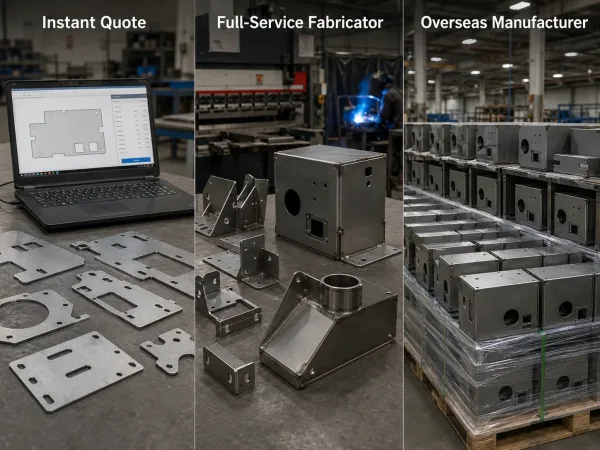
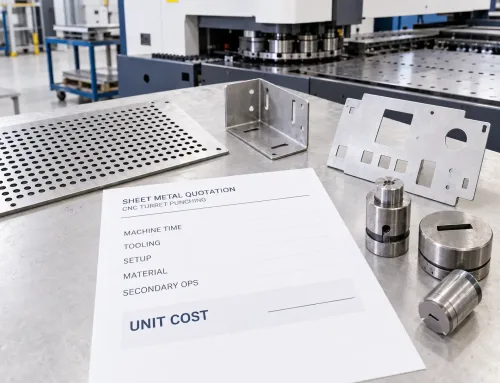
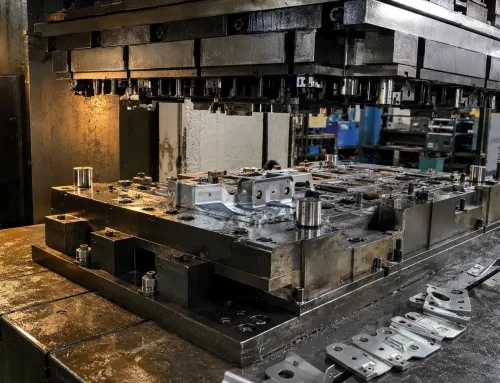
The right supplier model depends on part complexity, production volume, lead time, and required engineering support.
Instant-Quote Platforms
These are online services where you upload a CAD file, select a material and quantity, and receive a price within minutes. They use automated quoting engines that calculate cost based on geometry, material, and cut length. Parts ship in as little as one to three business days.
- Best for: Simple 2D profile parts, flat brackets, plates, enclosures — parts that need cutting and minimal secondary operations
- Strengths: Speed, price transparency, low friction for repeat orders
- Limitations: Limited or no DFM feedback; automated quoting does not flag design issues like impossible bend radii or missing tolerance callouts. Secondary operations (welding, complex forming, hardware insertion) may not be available or may be outsourced
- Typical volume: 1 to 500 units; unit price drops significantly at higher quantities but the platform may not support dedicated production runs
Full-Service Sheet Metal Fabricators
These are manufacturing shops that provide one-stop sheet metal manufacturing — laser cutting, bending, welding, finishing, and assembly under one roof. They quote through engineering review, not automated engines. A real person looks at your drawing, asks clarifying questions, and provides a quote that accounts for the full manufacturing sequence.
- Best for: Multi-process parts (cut + bend + weld + finish), assemblies, tight-tolerance components, parts that require DFM input
- Strengths: Engineering support, process control across multiple operations, ability to hold tolerances through the full fabrication sequence
- Limitations: Longer quoting turnaround (one to five business days), higher minimum order values, may not be cost-competitive for simple flat parts
- Typical volume: 10 to 10,000+ units; many support both prototyping and production
Overseas Manufacturers
Manufacturers in countries like China, India, or Turkey that offer laser cutting and full fabrication services, often at significantly lower unit costs. Communication happens through email, online portals, or sourcing agents.
- Best for: Medium to high volume production runs where unit cost is the primary driver and lead time can accommodate shipping
- Strengths: Cost advantage on larger quantities, access to a wide range of materials and processes, scalable production capacity
- Limitations: Longer lead times (typically two to six weeks including shipping), communication delays across time zones, higher cost of rework if parts arrive out of spec. DFM feedback may be limited unless explicitly requested
- Typical volume: 100 to 100,000+ units; some overseas manufacturers support small batches but at less competitive pricing
| Supplier Type | Typical Lead Time | Best Batch Size | DFM Support | Price Model | Best Fit |
|---|---|---|---|---|---|
| Instant-quote platform | 1–3 business days | 1–500 units | Minimal to none | Automated, per-part | Simple flat parts, fast turnaround |
| Full-service fabricator | 1–3 weeks | 10–10,000+ units | Engineering review included | Quoted per project | Multi-process parts, tight tolerances |
| Overseas manufacturer | 3–8 weeks (incl. shipping) | 100–100,000+ units | Varies; request explicitly | Quoted per project, lower unit cost | High-volume production, cost-sensitive |
Seven Criteria to Evaluate a Laser Cutting Supplier
Once you know which supplier type fits your project, use these criteria to compare options within that category.
Material and Thickness Range
Not every supplier carries every material. Common materials — cold-rolled steel (CRS), 304 stainless steel, 5052 and 6061 aluminum — are widely available. Less common materials — copper, titanium, thick-section stainless steel, specialty alloys — may require sourcing, which adds lead time and cost.
Before sending an RFQ, confirm that the supplier stocks (or can source) your material in the thickness you need. A supplier that lists “aluminum” but only carries 6061 in thicknesses up to 3 mm cannot produce your part from 6 mm plate without additional procurement.
Tolerance and Cutting Quality
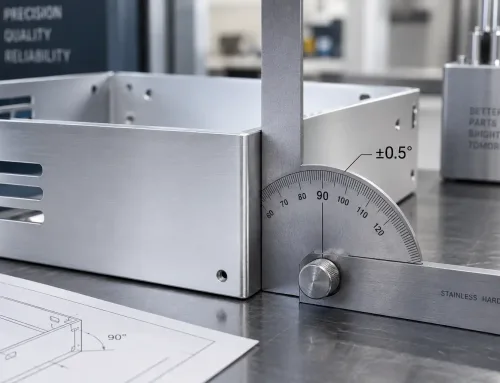
Laser cutting tolerances depend on the machine, the material, and the thickness. Standard laser cutting tolerances for sheet metal are typically ±0.1 mm (±0.004″) for features within the cutting area. Tighter tolerances — ±0.05 mm or better — are achievable but require slower cutting speeds, better machine calibration, and often secondary finishing.
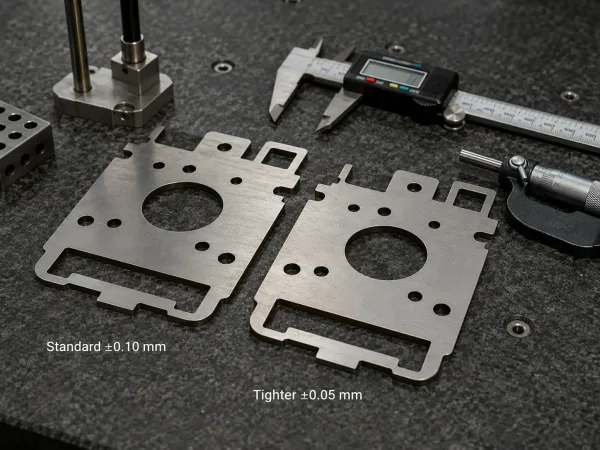
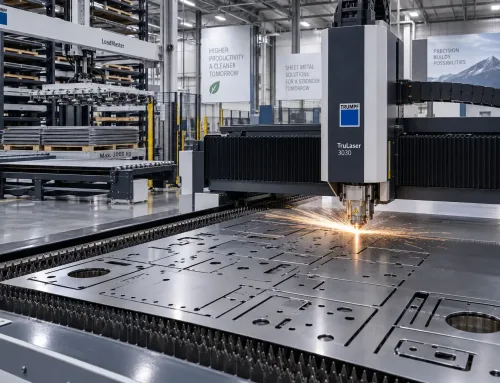
Laser cutting tolerance should be evaluated by what a supplier can consistently guarantee in production.
Ask potential suppliers what tolerances they guarantee, not what their machine is theoretically capable of. A supplier that quotes ±0.1 mm standard and ±0.05 mm on request is more transparent than one that simply says “high precision.”
Secondary Operations
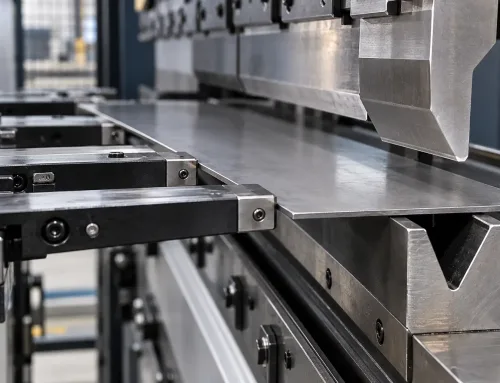
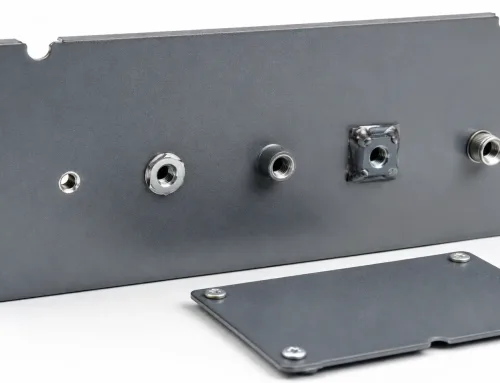
If your part requires bending, welding, tapping, hardware insertion, or surface finishing, confirm that the supplier can perform these operations in-house. A laser-cut flat part that needs to be bent and welded requires a different supplier than a flat part that only needs cutting and powder coating.
Outsourced secondary operations add lead time, increase the risk of handling damage, and create accountability gaps when a finished part does not meet spec — the laser cutter blames the bender, the bender blames the powder coater. A full-service fabricator that controls the entire sequence is more accountable and often faster.
Lead Time and Flexibility
Standard lead times vary by supplier type and workload. Instant-quote platforms advertise one to three days for cutting. Full-service fabricators typically quote one to three weeks for fabricated parts. Overseas manufacturers quote two to six weeks including shipping.
More important than the standard lead time is what happens when you need parts faster. Ask whether the supplier offers expedited service and what the premium is. A supplier that can compress a two-week lead time to five days for a 30% premium is more valuable than one that promises three days but consistently delivers in ten.
DFM and Engineering Support
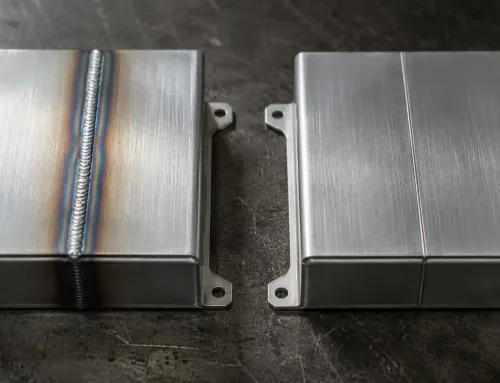
A sheet metal DFM review is the difference between a supplier that makes exactly what you drew and a supplier that tells you when your design will cost more than it should or fail in production. DFM input might include suggesting a larger bend radius to avoid cracking, flagging a hole too close to an edge, or recommending a material change for better weldability.
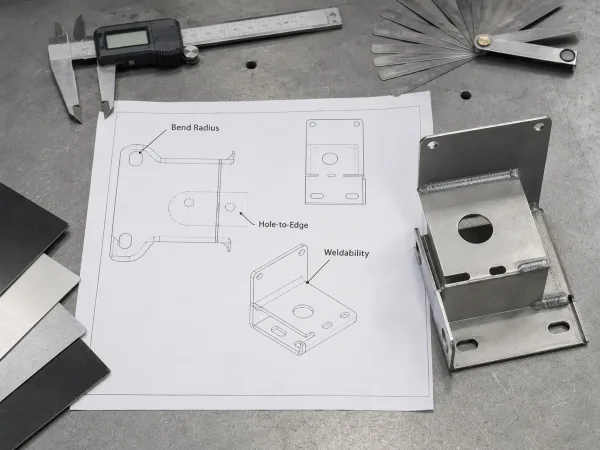
DFM review identifies manufacturing risks such as bend radius, hole placement, and weldability before production begins.
Not every project needs DFM review. Simple flat parts with standard tolerances can go straight to production. But for parts with tight tolerances, complex bends, weld joints, or critical fit requirements, DFM feedback before production saves rework costs and delays.
Quality System and Certifications
ISO 9001 certification is the baseline for any supplier that claims to have a quality management system. Industry-specific certifications — AS9100 for aerospace, ISO 13485 for medical, IATF 16949 for automotive — matter if your parts serve regulated industries.
Beyond certifications, ask how the supplier defines and controls its manufacturing quality requirements, including incoming material verification, in-process inspection, and final inspection. A supplier that measures first articles and maintains inspection records is more reliable than one that relies on visual checks.
Communication and Quoting Process
The quoting process reveals how a supplier works. A fast, clear quote that asks the right clarifying questions — material grade confirmation, tolerance requirements, surface finish specs — signals a supplier that pays attention to detail. A quote that arrives in two hours but makes no mention of tolerances or surface finish is a supplier that will ship parts based on their own assumptions.
File format support also matters. If your engineering team works in SolidWorks and the supplier only accepts DXF files, you add a conversion step and introduce the risk of data loss. STEP files preserve 3D geometry and are the safest format for complex parts. DXF and DWG work well for flat 2D profiles.
How Your Part Design Points to the Right Supplier Type
The seven criteria above help you evaluate any supplier. But your part itself narrows the field.
Simple 2D Profile Parts
Flat brackets, plates, panels, and enclosures with no bends or welds are the easiest parts to source. Instant-quote platforms handle these efficiently — upload the file, pick a material, get a price, and receive parts in days. There is little reason to pay the premium of a full-service fabricator for a flat laser-cut plate.
Multi-Process Assemblies
Parts that require cutting, bending, welding, hardware insertion, and finishing need a full-service fabricator. Splitting these operations across multiple suppliers creates coordination overhead and increases the risk of dimensional stack-up errors — each handoff introduces a new tolerance source.
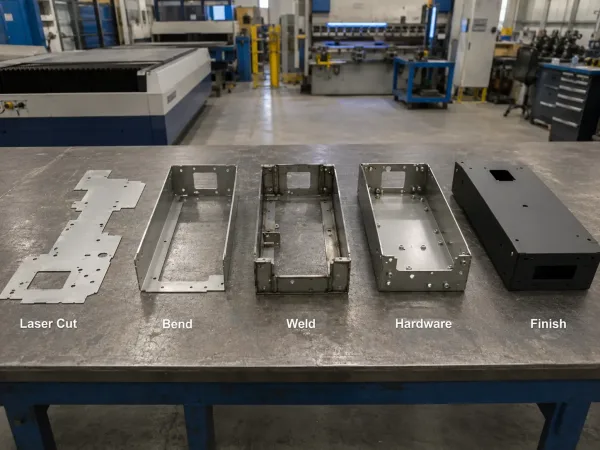
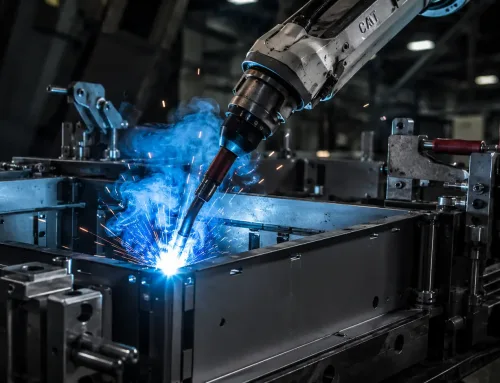
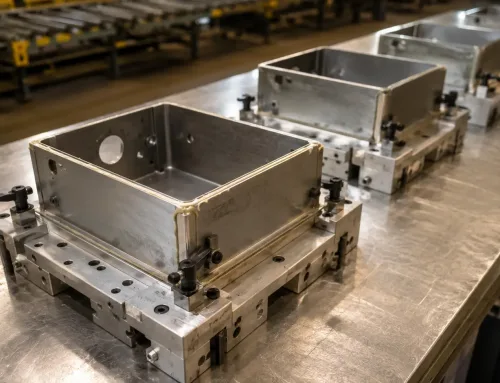
Multi-process parts are easier to control when cutting, bending, welding, hardware installation, and finishing are managed as one manufacturing sequence.
Tight-Tolerance or Specialty Material Parts
Parts with tolerances tighter than ±0.1 mm or made from materials like copper, titanium, or thick-section stainless steel require verified capability. Not every laser cutter can hold ±0.05 mm consistently, and not every shop stocks specialty materials. Confirm capability before committing.
Prototype vs. Production Runs
Prototyping and production have different priorities. For prototypes, speed and flexibility matter most — you need parts quickly to validate design and fit. For production, consistency and cost control become critical — you need every batch to match the first article.
A supplier that excels at prototyping may not be set up for production volumes, and a production-focused supplier may not be responsive to small prototype orders. Some suppliers handle both; many specialize. Clarify your volume expectations upfront to avoid switching suppliers mid-project.
What to Prepare Before You Send an RFQ
The quality of the quotes you receive depends on the quality of the information you provide. An incomplete drawing forces the supplier to make assumptions — and different suppliers will make different assumptions.
Drawing Information Checklist
Before sending your RFQ, use a sheet metal fabrication drawings and RFQ checklist to confirm your drawing includes:
- Material grade: “Steel” is not specific enough. Use “ASTM A36 CRS” or “304 stainless steel” or “5052-H32 aluminum.”
- Sheet thickness: Nominal thickness plus tolerance if critical (e.g., 1.5 mm ±0.05 mm).
- Dimensional tolerances: General tolerances per a standard (e.g., ISO 2768-m) plus critical feature tolerances called out individually.
- Surface finish requirements: Specify Ra value or gloss units, not just “smooth” or “matte.”
- Bend specifications: Bend radius, angle, and direction. Indicate which surfaces are cosmetic.
- Weld requirements: Weld type, size, and location. Reference a welding standard if applicable.
- Quantity: Quote for the exact quantities you need, including prototype and production volumes if both are planned.
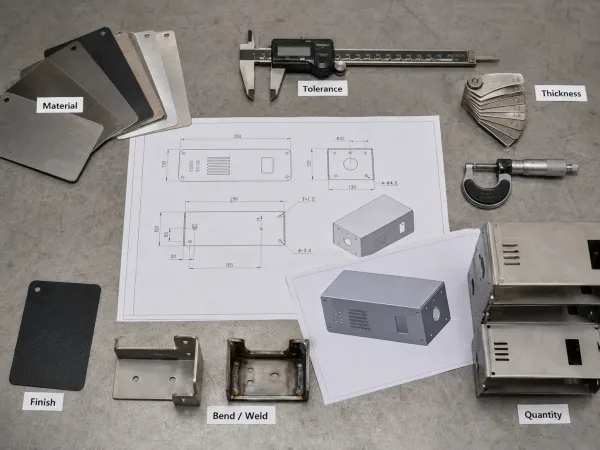
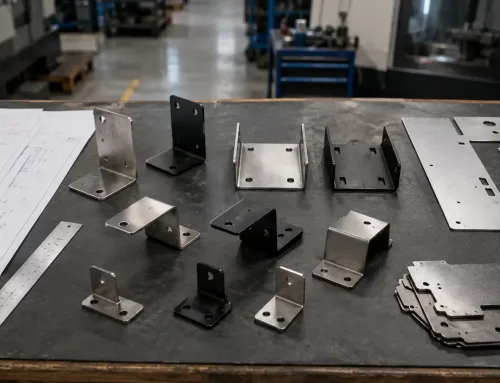
A complete RFQ should clearly define material, thickness, tolerances, finishing, fabrication requirements, and quantity.
File Format Compatibility
STEP files are the safest format for 3D parts — they preserve solid geometry and are readable by virtually all CAD/CAM systems. DXF and DWG are appropriate for flat 2D profiles. Avoid sending PDF drawings as the sole source file; they cannot be used for automated quoting or CNC programming.
How Incomplete Drawings Affect Your Quote
When a drawing omits a tolerance, the supplier applies their own standard — which may be ±0.5 mm for general features, far looser than what you need. When a drawing omits a surface finish, the supplier ships raw-cut parts with no deburring or finishing. When a drawing omits a material grade, the supplier chooses the cheapest option that matches the description.
In each case, you receive a lower quote — and then discover the parts do not meet your requirements. Clarification after the fact costs more than clarity upfront.
Common Mistakes When Choosing a Laser Cutting Supplier
Choosing based on the lowest unit price alone ignores the total cost of ownership. A supplier that is $0.50 cheaper per part but requires you to manage bending, finishing, and assembly separately may cost more in coordination time, shipping, and handling damage than a single-source fabricator.
Not verifying tolerance capability before ordering is another common error. A supplier that lists “precision cutting” on their website may not guarantee tolerances tighter than ±0.2 mm. If your part requires ±0.05 mm, you need written confirmation — not marketing language.
Sending the same RFQ to ten suppliers and choosing the cheapest response without evaluating why prices differ is a false economy. If one quote is 40% below the others, it is worth asking what the supplier is excluding — material certification, finishing, inspection, packaging — before assuming it is a better deal.
Switching suppliers between prototype and production without a qualification process introduces risk. The new supplier has not made your part before. Their first batch may require adjustments to tooling, fixturing, or process parameters. Budget time and cost for a first-article inspection when onboarding a new production supplier.
FAQ
et a DFM Review for Your Custom Sheet Metal Parts
Before you send your next RFQ, consider having your drawing reviewed for manufacturability. SR-MFG offers free DFM review for custom sheet metal parts — our engineering team will check your drawing for tolerance feasibility, material availability, bend sequence, and potential cost drivers. Send us your drawings and we will help you determine the right approach for your project.