
Procurement teams often record “lot” and “heat number” as if they were the same field, or treat a lot as nothing more than a label on the shrink wrap. Both shortcuts surface at the worst possible moment: when a quality problem forces you to identify every part that came from one batch of material. A material lot is a defined quantity of material managed as a single unit — received, identified, stored, and issued together under shared records. For sheet metal orders in particular, the distinction matters, because one heat of steel can be split across several deliveries and several work orders.
What a Material Lot Actually Is
In procurement and production, a material lot groups stock that shares one origin event and one controlled history: typically a single delivery against one specification, received under one inspection status. The lot is a management unit, not a decoration on the package. Every downstream action — where the material is stored, which work order consumes it, what happens to a leftover sheet, which inspection result applies — attaches to that unit.
What Makes Materials “the Same Lot”
Material belongs to the same lot while it shares the same receiving event and the same status. The moment something changes — part of the bundle is placed on quality hold, a second delivery arrives, a remnant returns to stores without its label — the shared history breaks, and the remaining quantity can no longer be treated as one traceable group. Lot boundaries are administrative decisions, not just numbers: they mark the point up to which records can be reconstructed with confidence.
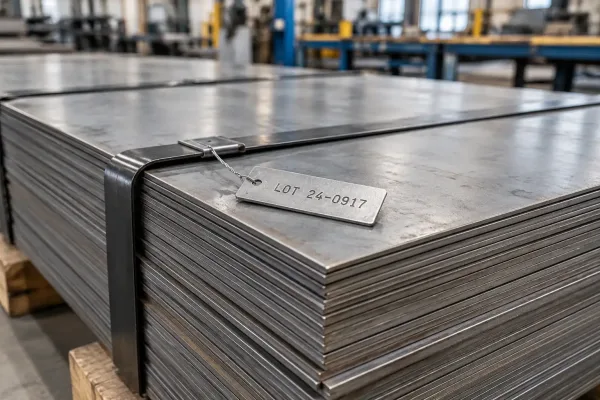
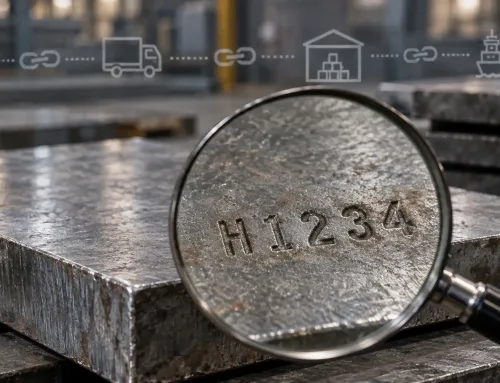
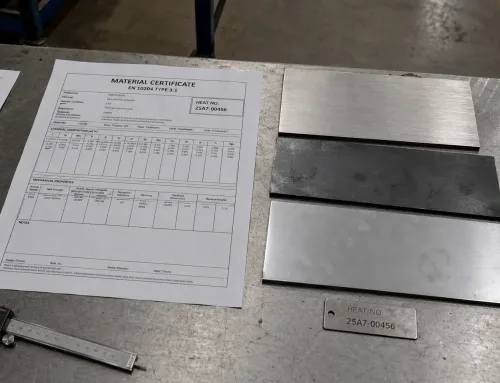
One delivery of sheet steel bound together and marked with a single lot tag.
Material Lot vs. Heat Number: What Each One Traces
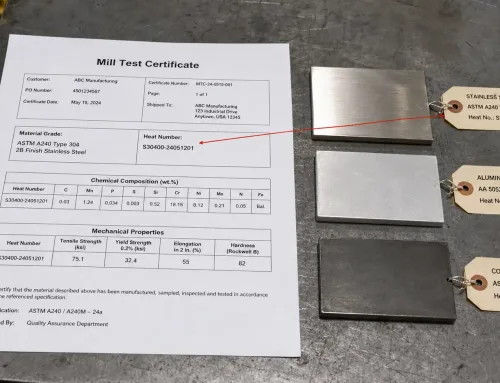
A heat number identifies one melt. It is assigned by the mill to the specific furnace run that produced the steel or aluminum, stamped or stenciled on the surface of the stock, and referenced on the MTR — the Material Test Report, which lists the chemical composition and mechanical properties measured for that melt. When you receive an MTR, you are receiving data about a heat.
A material lot identifies the quantity you actually manage. It may be one coil, one bundle, or one shipment, and it is usually assigned at receipt by whoever controls inventory — your supplier, your fabricator, or your own stores. The lot carries logistics and status: quantity received, quantity issued, inspection state, storage location.
Where the Two Connect — and Where They Split
The two identifiers link at receipt, when the record stores the heat number found on the material. From there they diverge in practice. A single heat is often split across several shipments, so one heat number can appear in multiple lots; less commonly, a mixed shipment groups material from more than one heat into a single lot. Recording the cross-reference in both directions — every lot knows its heat, every heat knows its lots — is what lets a traceability query return the right scope. Record only one side, and the query either misses parts it should catch or quarantines parts that were never at risk.
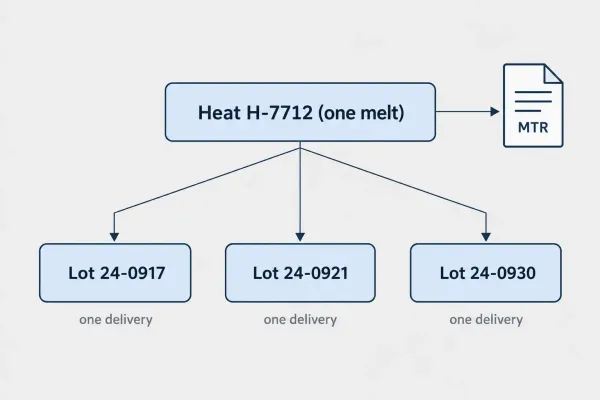
A single mill heat divided into three delivery lots, each linked to one MTR.
Where Lot Isolation Actually Happens
Lot isolation means keeping different lots physically and visually separated so that no operation can mix them without leaving a record. In a sheet metal order, it is enforced at four points:
- Receiving. Each delivery is labeled with its lot identifier and heat number before it enters stores. Unlabeled material does not go on the rack.
- Storage. Lots of the same specification sit in marked bins or sections. When rack space forces proximity, the labels must stay readable from the aisle.
- Remnants. A partially used sheet keeps its lot label when it returns to storage. An unlabeled remnant has lost its history and cannot be released for critical work.
- Shop floor. The traveler — the route sheet that follows a job through cutting, bending, and welding — carries the lot number, so consumed material stays linked to the parts it became.
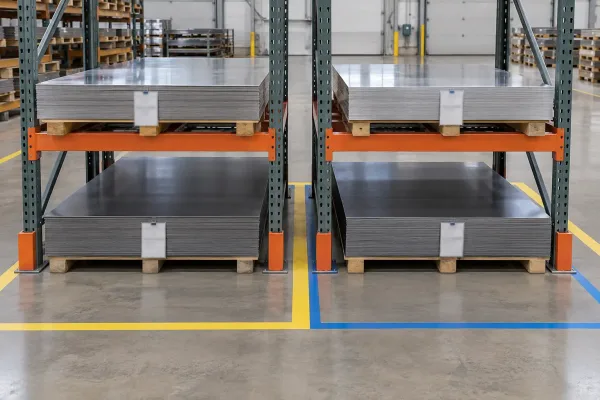
Lots of the same specification stored in clearly separated, labeled sections.
Isolation fails quietly. Mixed stock looks identical to compliant stock until an assembly-level defect triggers a backward trace. At that point a missing label turns a targeted check into a full shipment quarantine.
The Records a Lot Must Carry
A lot number by itself proves nothing; the lot record is what makes traceability work. At minimum, each lot entering production should carry the following information:
| Field | Why it matters |
|---|---|
| Lot identifier | The reference printed on labels, travelers, and shipping documents |
| Supplier and PO reference | Connects the lot to the order it was bought against |
| Heat number | Links the lot to mill data and the MTR |
| Receipt date and quantity | Establishes when the lot entered inventory and how much remains |
| Specification / grade | Confirms which material requirement the lot satisfies |
| Inspection status | Shows whether the lot is approved, on hold, or rejected |
| Certificate link (MTR / CoC) | Attaches the test report to the physical stock |
With these fields in place, a quality question can be answered from internal records. Without them, every traceability query becomes a request to the supplier — and supplier responses arrive on supplier time, usually after your customer is already waiting.
How Lot Information Traces a Sheet Metal Order
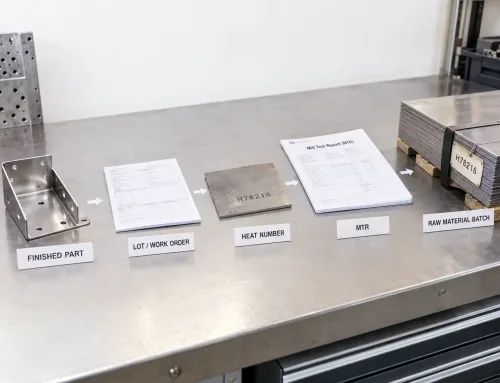
Traceability runs in two directions. Backward, a finished enclosure panel leads to its work order, the cutting plan, the material lot, the heat number, and finally the MTR filed at receipt. Forward, one lot number answers a different question: every part, assembly, and shipment that lot contributed to.
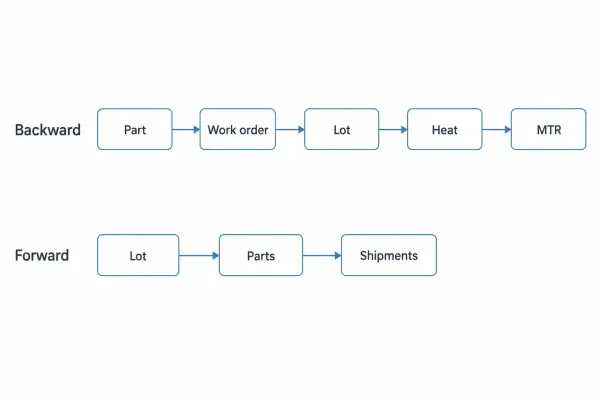
Backward trace from finished part to MTR, and forward trace from lot to shipments.
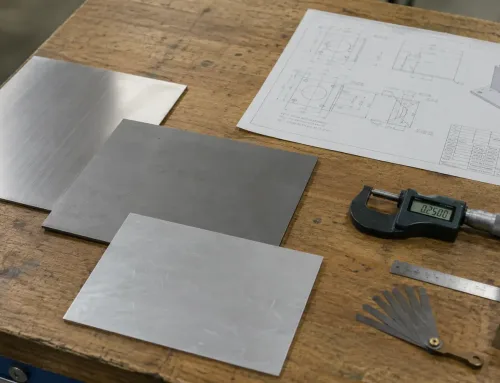
Sample parts and first articles belong in this chain. When a sample is inspected and accepted, its material lot should appear in the report alongside the dimensional results. If a defect later shows up in production, matching the lot records reveals whether the same incoming batch was involved — or whether the problem starts at a delivery boundary. That boundary is the practical value of lot control: when a new lot arrives, the scope of any future quality event stops at the previous lot instead of spanning the whole quarter.
How to Specify Lot Requirements Before You Order
The RFQ stage is the cheap place to define traceability; after delivery it becomes a dispute. RFQ means request for quotation — the document on which suppliers base their price and lead time. Buyers who want lot control should put four things in writing before quoting begins:
- Traceability depth. State whether lots must link to heat numbers and MTRs, or whether lot-level records alone are acceptable.
- Document pairing. Require the lot-to-MTR cross-reference to travel with the shipment paperwork, not in a separate email.
- Sample linkage. Ask for first-article or sample reports to record the material lot that was used.
- Remnant handling. Confirm that partial sheets return to stock with labels intact, and state whether unlabeled remnants may be used on your parts.
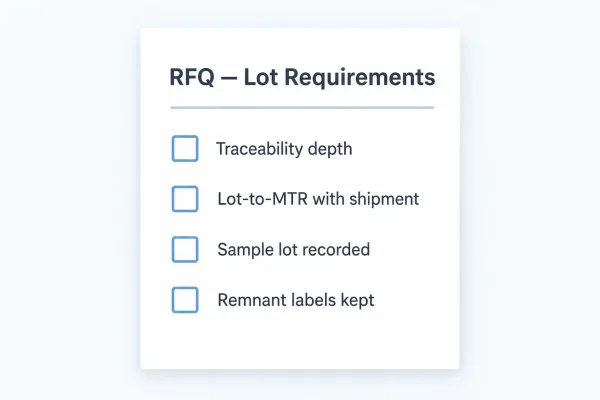
The four lot requirements to include in an RFQ before quoting begins.
Suppliers plan and price for the records you require. A request made at purchase-order stage is routine; the same request after an incident is a change order. Treat lot requirements the way you treat tolerance and surface finish — as quote inputs that belong on the RFQ — and raise them with your fabricator’s engineering team when the drawing package is reviewed, not when the shipment is late.