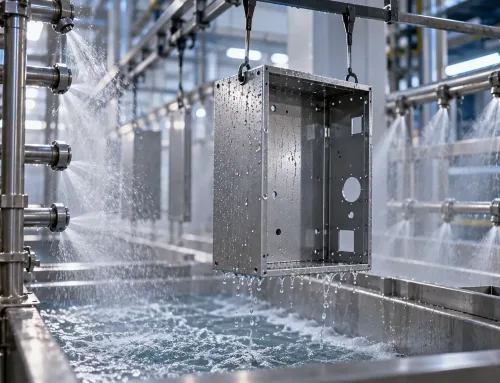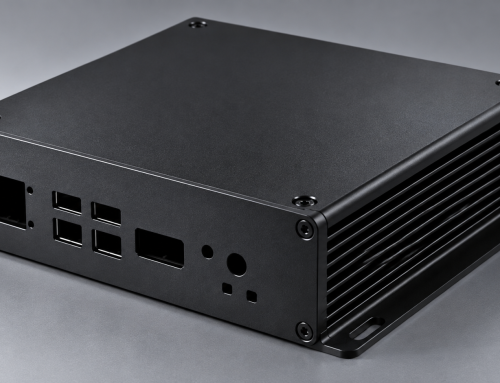

Wrinkle finish powder coating is easy to file under “decorative textures.” On industrial cabinets, that classification misses half the value. The same three-dimensional surface that gives a control enclosure its distinctive low-gloss appearance also hides weld discoloration, resists fingerprints on a panel that gets opened daily, and keeps a production run of twenty cabinets looking like one.
“Wrinkle Finish Is Just Decoration” — And Why That Classification Costs You
Many engineers and buyers treat wrinkle finish as the “nicer-looking” option and select it on visual preference alone. That approach works until the first production batch shows visible texture variation, or a customer complains about glare on a smooth-finish cabinet. The real case for wrinkle finish is functional — it solves problems that smooth powder coating on fabricated sheet metal cannot.
What Wrinkle Finish Actually Hides on a Fabricated Cabinet
Sheet metal fabrication leaves marks. Weld seams on cabinet frames produce heat-affected zone discoloration. Press-brake operations leave faint bend lines on visible surfaces. Handling during assembly leaves micro-scratches that catch the light on a glossy finish. A wrinkle texture — because it is deliberately three-dimensional — scatters light across its peaks and valleys rather than reflecting it in a single direction. The result is that minor surface irregularities blend into the texture instead of standing out.
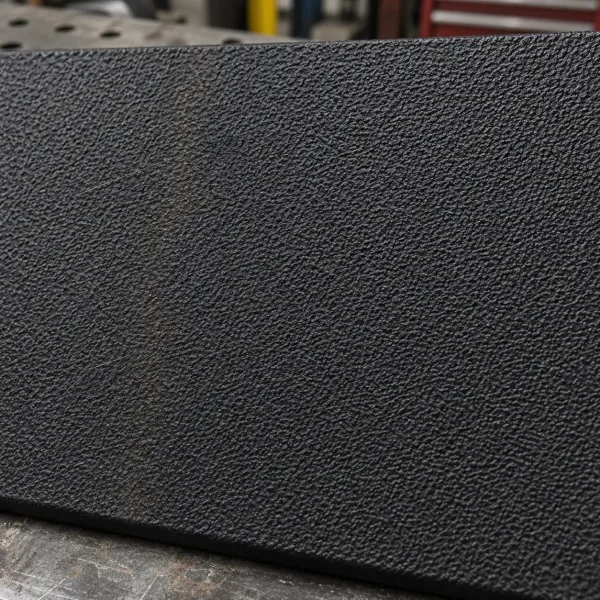
A close-up view of a black wrinkle finish surface on sheet metal, showing how the three-dimensional texture conceals weld discoloration and handling marks.
This is not a claim that wrinkle finish replaces proper fabrication — welds should still be dressed where appearance matters. But on a large cabinet door or side panel, the tolerance for “looks acceptable at arm’s length” is much wider with a wrinkle texture than with a smooth finish.
Glare, Fingerprints, and Handling Marks: The Functional Side of Texture
Industrial cabinets get touched — maintenance personnel open doors weekly, operators lean against side panels. A smooth powder-coated surface shows fingerprints under directional lighting. Wrinkle finish disperses both light and fingerprint oils so neither is as visible. For cabinets under fluorescent or LED shop lighting, the matte textured surface is a practical advantage.
How Wrinkle Texture Forms — And Why It Is Controllable
Wrinkle finish is not random roughness. It is a controlled surface morphology produced by the powder coating chemistry itself. Wrinkle powders contain curing agents formulated so that the outer layer of the coating film cross-links and shrinks faster than the layer underneath. As the surface dries and contracts over a still-soft substrate, it buckles into a uniform network of fine wrinkles — similar in principle to how a drying skin forms over a thicker liquid layer.
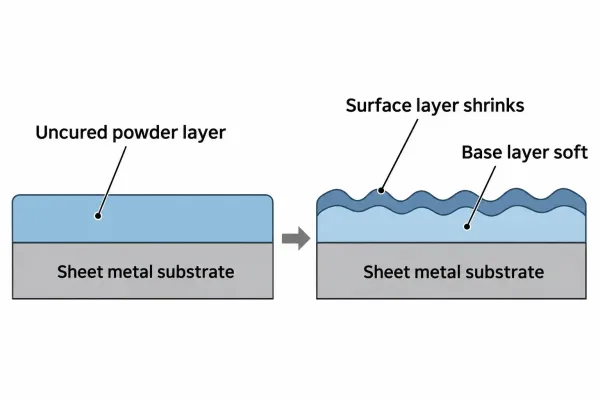
A simplified cross-section diagram illustrating how the outer coating layer shrinks faster than the inner layer during cure, forming the wrinkle texture.
The key point for engineers and buyers: wrinkle texture is not a fixed property of “wrinkle powder.” The final texture — its depth, wavelength, and uniformity — depends on controllable process variables:
| Variable | Effect on Wrinkle Texture |
|---|---|
| Film thickness | Thicker films generally produce coarser wrinkles; too thin and the texture may not fully develop |
| Cure temperature and time | Under-cure leaves a tacky, poorly defined texture; over-cure can flatten or discolor the wrinkle |
| Powder formulation | Different suppliers use different resin/curing agent systems, producing fine, medium, or coarse wrinkle patterns |
| Substrate pretreatment | Poor adhesion (inadequate phosphating or chromating) causes texture defects regardless of powder quality |
This is why a sample panel approved in a lab does not guarantee identical texture on production parts. The cure oven profile, film build on complex geometries, and pretreatment consistency all shift the result. We will come back to this in the manufacturing-control section.
Why Industrial Cabinets Are a Natural Fit for Wrinkle Finish
Industrial cabinets share surface requirements that align with what wrinkle finish delivers.
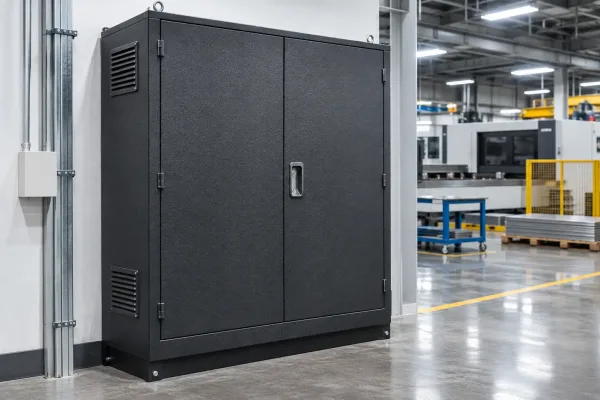
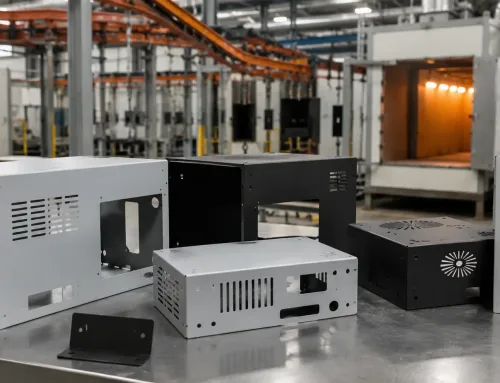
A wrinkle finish coated industrial cabinet installed on a factory floor, showing its low-gloss appearance under overhead lighting.
Large, flat visible panels (doors, side walls) demand appearance consistency across a production run. A wrinkle texture is more forgiving of minor substrate variation than a smooth finish, because the eye reads the overall pattern rather than individual defects.
Cabinets operate where fingerprints, dust, and light contact are constant — a textured surface shows less daily wear than a smooth one.
Welded frames with formed sheet metal panels benefit from the visual continuity wrinkle texture provides across weld seams and bend transitions.
Many OEM customers prefer a low-gloss, professional appearance for equipment visible to their own customers. Black wrinkle is the most common choice, but wrinkle powders come in a range of industrial colors.
Wrinkle vs. Smooth vs. Sandpaper: Choosing the Right Texture for a Cabinet
Before specifying wrinkle finish, it is worth comparing the three most common powder-coat textures for cabinet applications. Each occupies a different balance between aesthetics, function, and cost.
| Factor | Wrinkle Finish | Smooth Finish | Sandpaper (Fine Texture) |
|---|---|---|---|
| Surface profile | Three-dimensional, uniform wrinkle network | Flat, continuous film | Fine, even micro-roughness (no wrinkle pattern) |
| Defect hiding | Excellent — blends weld marks, minor scratches | Poor — defects are visible under light | Good — similar to wrinkle but less forgiving of deep marks |
| Fingerprint visibility | Low | High | Moderate |
| Glare reduction | Strong | Weak (even with matte topcoat) | Moderate |
| Cleanability | Slightly harder to wipe clean (texture traps fine dust) | Easy to wipe | Moderate |
| Color availability | Wide (black is standard; RAL colors available) | Widest | Wide |
| Relative cost | 10–20% above standard smooth, depending on powder and volume | Baseline | Comparable to wrinkle |
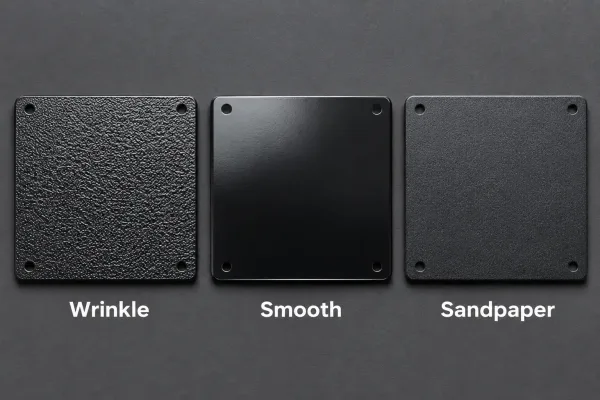
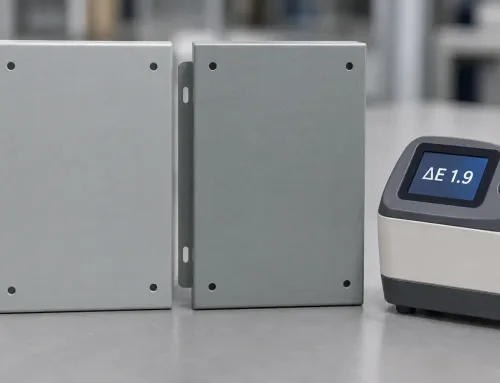
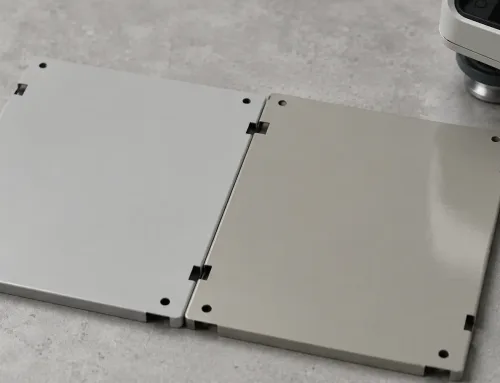
Three powder-coated sheet metal panels shown side by side — wrinkle, smooth, and sandpaper texture — under the same lighting for direct comparison.
A smooth finish may still be the right choice when cleanability is the top priority (e.g., food-adjacent or cleanroom environments) or when a high-gloss appearance is specified. Sandpaper texture is a middle ground — it reduces glare without the pronounced wrinkle pattern. But for general-purpose industrial cabinets where appearance consistency and defect hiding matter, wrinkle finish offers the best balance.
What Actually Controls Wrinkle Consistency on Sheet Metal Parts
This is where the gap between “specifying wrinkle finish” and “receiving consistent wrinkle finish” usually appears. On a flat sample panel, almost any powder looks fine. On a fabricated cabinet with welds, bends, edges, and varying panel sizes, texture consistency becomes a real manufacturing challenge.
Pretreatment matters more than most buyers expect. Before powder coating, sheet steel typically goes through a phosphating or chromating process that creates a conversion coating for adhesion. If pretreatment is inconsistent — for example, oil residue from stamping is not fully cleaned — the powder may cure with a different texture in that area, or adhesion may fail.
Film thickness must be uniform across the part. Wrinkle texture depth correlates with film build. A cabinet door with recessed features may accumulate more powder in corners (Faraday cage effect is less of an issue on large panels, but edges and interior angles still see higher build). A common specification is 60–100 μm for wrinkle powder; staying within a defined range is more important than hitting a single number.
Cure oven temperature uniformity directly affects texture. If one zone of the oven runs 10°C hotter than another, cabinets passing through that zone may show a different wrinkle pattern than those from the cooler zone. This is one of the most common causes of “batch-to-batch variation” complaints.
Weld seams and sharp edges need attention. Weld beads create local geometry changes that affect powder flow and texture development. Sharp edges common on laser-cut sheet metal tend to have thinner film coverage and may show a different texture or premature wear. Specifying a minimum bend radius (≥ 1× material thickness for mild steel) and weld dressing on visible surfaces reduces these issues.
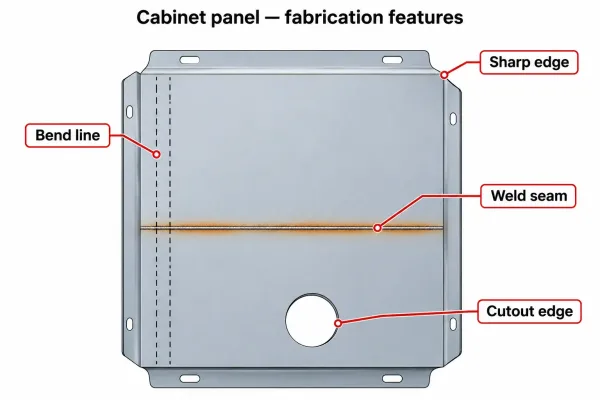
An annotated diagram of a fabricated sheet metal panel identifying weld seams, bend radii, and laser-cut edges where wrinkle texture may vary.
Sample-to-production gap is real. Always approve a production-representative sample — a panel from the same material, thickness, pretreatment line, and cure oven that will run your order. A lab coupon tells you the powder works; it does not guarantee the production process will reproduce it.
How to Specify Wrinkle Finish on Drawings and RFQs
A purchase order that says “wrinkle finish, black” leaves at least five decisions to the supplier’s assumption. Each of those assumptions can differ between quotes — and each difference becomes a dispute at delivery.
Specify these five elements on the drawing or in the RFQ:
| Element | What to Specify | Example |
|---|---|---|
| Texture type | Fine, medium, or coarse wrinkle; or reference a standard sample | “Fine wrinkle, per approved sample panel A-001” |
| Color | RAL number, Pantone reference, or physical color chip | “RAL 9005, Jet Black” |
| Film thickness | Range in micrometers | “60–90 μm DFT (dry film thickness)” |
| Coverage area | Which surfaces receive the finish; mask or exclude as needed | “Exterior surfaces only; mask all grounding points and mounting threads” |
| Acceptance criteria | Color tolerance, texture uniformity, adhesion standard | “ΔE ≤ 1.5 vs. master sample; adhesion per ASTM D3359, Class 4B or better” |
When these five elements are written down, the fabricator can quote accurately, the coater can process consistently, and incoming inspection has a measurable basis for acceptance. Without them, the supplier prices the simplest interpretation — and the buyer absorbs the risk of everything left unsaid.
How to Inspect and Accept Wrinkle Finish on Production Parts
Acceptance criteria for wrinkle finish should be defined before the first production batch. The most practical inspection points are:
- Texture uniformity: Visual and tactile comparison against an approved master sample under directional lighting — inspect at an angle, not straight-on.
- Color consistency: Measure with a spectrophotometer if ΔE tolerance is specified. For black wrinkle on large panels, color shift across the panel is usually less of an issue than texture variation — but for colored wrinkle finishes, batch color matching is worth checking.
- Adhesion: Cross-cut tape test (ASTM D3359) on a representative area. Wrinkle textures can mask adhesion problems — a finish may look acceptable but peel under impact. A tape test at incoming inspection is inexpensive insurance.
- Film thickness: Magnetic or eddy-current gauge readings at 5+ points per panel (edges and recessed areas included) to confirm the process held within range.
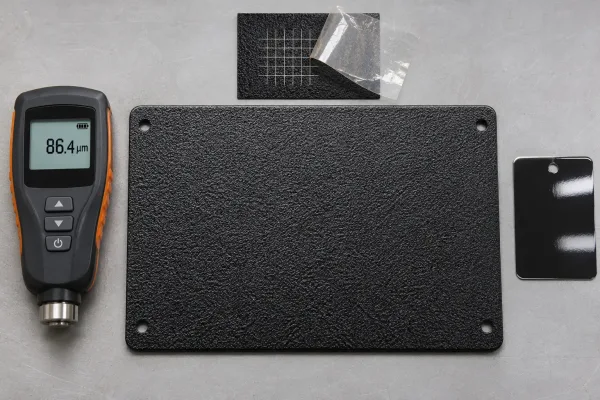
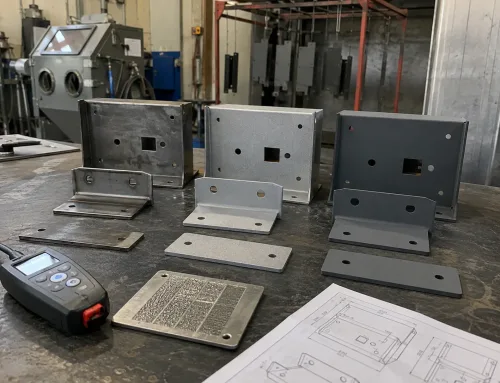
An inspection setup showing a coated cabinet panel alongside a film thickness gauge, a cross-cut test area, and a master color sample for comparison.
For first-article inspection (FAI), document all four points and retain the physical sample. For production runs, a sampling plan (visual + one adhesion test per batch) is usually sufficient unless the application is safety- or appearance-critical.
Final Thoughts
Wrinkle finish powder coating earns its place on industrial cabinets through engineering performance. It hides fabrication marks, reduces glare and fingerprints, and keeps large panels consistent across a production run. But the texture you receive is only as good as the specification you write and the process controls your fabricator and coater maintain. For your next cabinet project, define the five specification elements on the drawing before the RFQ goes out — that single step prevents more downstream disputes than any other.